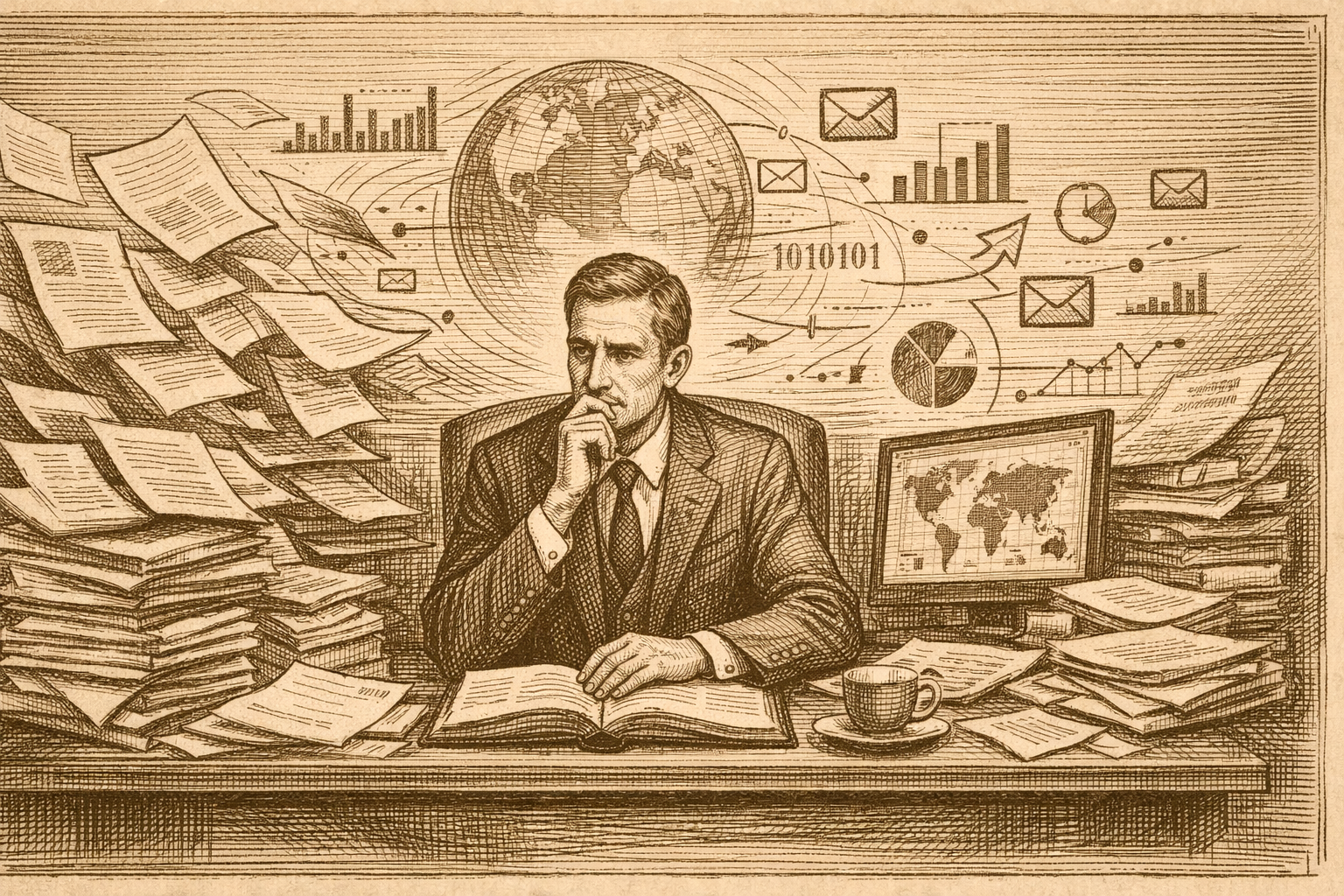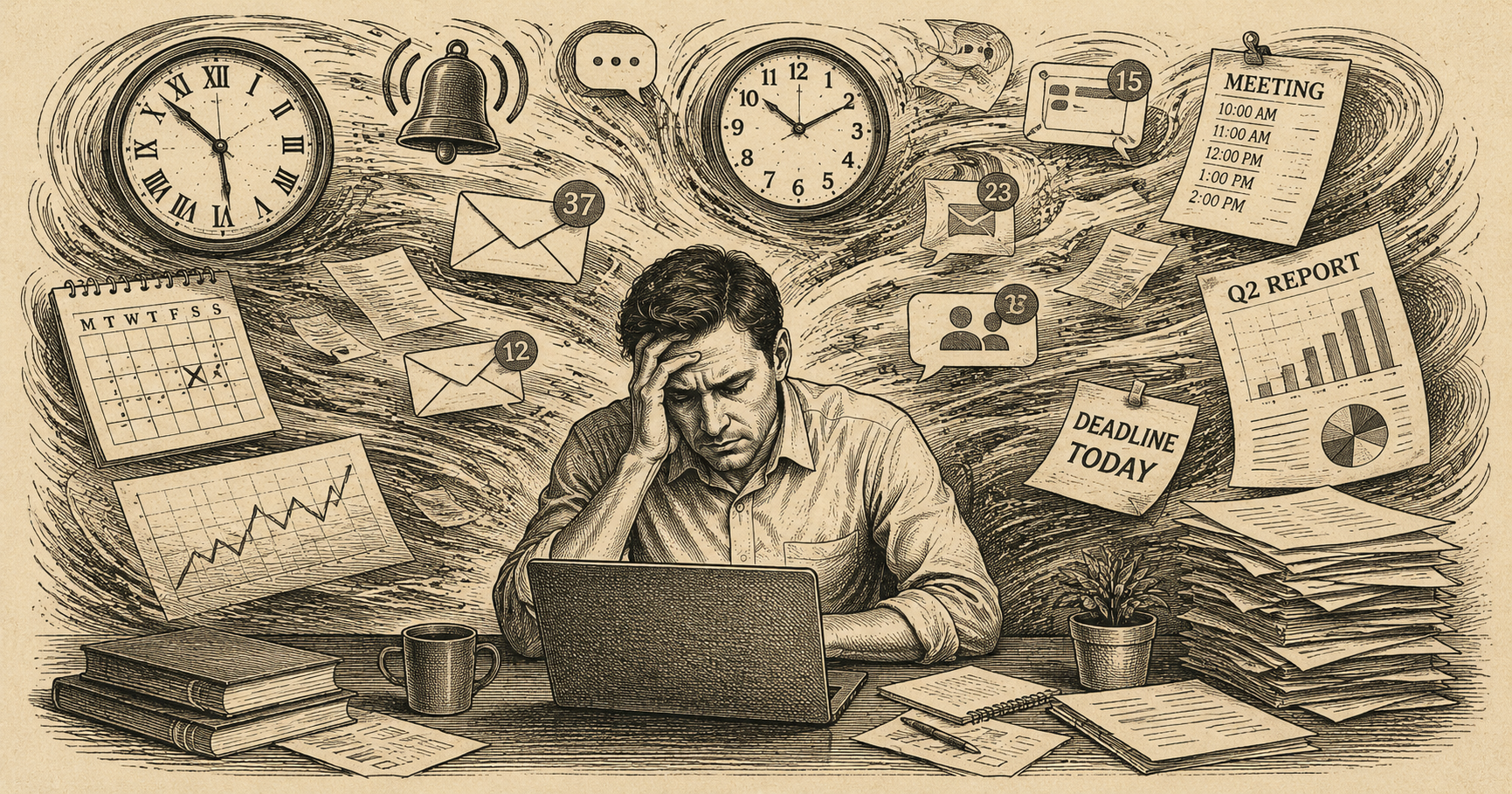
Modern workplaces have never been more technologically advanced. Organizations operate through real-time communication systems, digital collaboration platforms, artificial intelligence tools, and continuous streams of information designed to improve workplace productivity. Yet despite these advances, many professionals increasingly feel overwhelmed, mentally exhausted, and strangely unproductive.
This contradiction defines what can now be described as the silent productivity crisis.
Employees remain continuously active throughout the day. They do many works. From responding to emails, attending meetings, switching between applications to managing endless notifications.
Yet, in practice, many finish their workday feeling that little meaningful progress was actually achieved. The modern workplace has become highly efficient at generating activity, but not necessarily at creating deep, valuable intellectual output.
We notice a different value system. Research around deep work, cognitive overload, and workplace productivity are increasing and that suggests that the problem is not a lack of effort. The deeper issue involved is that modern work systems often reward visible responsiveness more than sustained concentration. (reclaim.ai)
Why Workplace Productivity Is Declining Despite Better Technology
For decades, technology was expected to improve productivity by reducing friction and accelerating execution. Digital communication, automation systems, and collaborative tools promised faster decisions and smoother coordination across organizations.
In many ways, these systems succeeded.
Work that previously required days can now be completed in minutes. Teams communicate instantly across continents. Artificial intelligence can summarize reports, generate analyses, and automate repetitive processes.
However, while operational speed has increased dramatically, cognitive performance has not necessarily improved at the same pace.
The modern employee now operates inside an environment of continuous interruption. Notifications arrive constantly, communication platforms compete for attention, and expectations for immediate responsiveness create a state of perpetual mental engagement.
This has created a productivity paradox. Employees appear busier than ever, yet deep concentration, which is the foundation of meaningful knowledge work, is becoming increasingly rare in the workforce.
Research on deep work and cognitive performance shows that sustained focus is essential for complex thinking, strategic problem-solving, and high-quality creative output. However, modern workplace structures offer environments that often fail to get the attention before deep concentration can fully develop. (reclaim.ai)
The Rise of Cognitive Overload in the Digital Workplace
One of the most important drivers of the silent productivity crisis is cognitive overload.
Cognitive overload occurs when professionals are required to process more information, decisions, and interruptions than the human mind can comfortably manage. In digital work environments, this condition has become increasingly common.
Employees in organizations today move continuously between multiple works. The most notables are messaging platforms, video meetings, data dashboards of organizations, endless emails, project management systems and software, and also recently AI-generated reports.
Each transition consumes mental energy. Over time, constant task-switching reduces clarity, weakens concentration, and increases decision fatigue.
Research on cognitive overload suggests that excessive information flow, in all probability, can actually impair judgment rather than improve it. Instead of helping professionals think better, this state of information saturation often creates confusion, stress, and mental fragmentation. (The Muse)
Notice here that the most concerning aspect of cognitive overload is that it often remains invisible inside organizations. Employees continue functioning, attending meetings, and responding to communication, while quietly experiencing declining cognitive performance.
Why Deep Work Is Becoming a Competitive Advantage
As mental distraction increases, the ability to perform deep work is becoming increasingly valuable.
Deep work refers to periods of uninterrupted concentration dedicated to cognitively demanding tasks. In modern knowledge economies, this type of focused effort is often responsible for strategic thinking and innovation, analytical insight and high-quality problem-solving.
Yet this kind of deep work phase is becoming increasingly difficult to protect.
Research cited in discussions around deep work suggests that employees frequently switch attention within very short intervals during digital workdays.
Continuous interruptions prevent the brain from entering sustained states of concentration necessary for meaningful intellectual output. (reclaim.ai)
This creates a new workplace reality.
The professionals who can protect their attention and sustain deep concentration may increasingly outperform those who simply remain continuously active.
In many modern organizations, focus itself is becoming a strategic capability. There we notice that human capability is becoming the ultimate advantage.
The Hidden Cost of Meetings and Constant Communication
Inter-departmental collaboration and employee-employee collaboration remains essential in modern organizations. However, excessive communication creates unintended consequences.
Across the organizations, many professionals now spend large portions of their day inside recurring meetings, alignment discussions, status updates, and communication loops.
While these interactions are designed to improve coordination, they often reduce the uninterrupted time necessary for focused execution.
This creates an important imbalance inside organizations.
Systems become optimized for synchronization rather than meaningful production. Employees remain constantly connected to organizational activity, yet struggle to find time for deep strategic work.
The result is a workplace environment where communication volume expands faster than meaningful progress.
Studies related to workplace productivity increasingly show that interruptions, excessive collaboration, and fragmented workflows reduce cognitive performance and increase mental fatigue. (circles.com)
Artificial Intelligence and the New Productivity Challenge
Artificial intelligence introduces another layer to the silent productivity crisis.
AI systems undoubtedly improve efficiency in many operational areas. They accelerate data processing, automate repetitive tasks, and generate insights at extraordinary speed. However, AI also increases the volume of information flowing through organizations.
In organizations, employees now review many types of reports. These may include, AI-generated summaries, automated analyses, predictive recommendations, machine-generated content.
This changes the nature of work itself.
Professionals spend less time manually producing information and more time validating, interpreting, filtering, and managing information generated automatically. In many cases, AI reduces manual effort while simultaneously increasing cognitive demand.
This creates what may become one of the defining workplace tensions of the next decade:
technological acceleration without cognitive simplification.
Technology may optimize systems while still overwhelming the people operating within them.
Why Leadership Fatigue Is Increasing
The leaders are the most affected ones. The silent productivity crisis affects leaders particularly strongly because they sit at the center of organizational information flow. It is clear that the leaders struggle to decide even with more information.
We expect the modern leaders are to process continuous streams of information, make decisions rapidly, coordinate distributed teams, and respond to uncertainty constantly and instantly.
For every additional communication channel, dashboard, and digital platform, there is a increases of cognitive pressure.
Some aspects are being explored in broader discussions around leadership and decision-making. Modern leadership increasingly involves filtering noise rather than simply gathering information.
The challenge here is no longer information scarcity. It is information saturation. This aspect changes the nature of leadership itself.
So, we may safely say that the future leader will not only consume the high-volume information but also she will be required to maintain the greatest clarity amidst complexity.
The Shift from Visible Activity to Meaningful Work
Some organizations are beginning to recognize that productivity cannot be measured purely through visible activity.
Fast responses, constant engagement, and continuous communication may create the appearance of efficiency while quietly damaging cognitive quality and strategic thinking.
As a result, there is growing interest in workplace models that protect deep work and cognitive performance. These models should also benefit focused contribution and sustainable productivity.
Some organizations are introducing meeting-free work periods, asynchronous communication systems, and structured focus environments. These environments are designed to reduce distraction and improve workplace productivity.
These fundamental changes reflect a broader realization. Our sustainable performance will depend not only on speed, but also on mental clarity with which it is carried out.
What the Silent Productivity Crisis Means for Young Leaders
For emerging leaders, the silent productivity crisis offers an important lesson about the future of work.
Success will increasingly depend not on appearing constantly busy, but on maintaining the ability to think clearly, prioritize effectively, and focus deeply in environments filled with distraction.
This requires a different mindset toward productivity.
The most valuable professionals may not be those who respond fastest to every input. They may be those who understand which problems truly deserve sustained attention.
The present-day economy is increasingly shaped by information overload, cognitive overload, and continuous interruption. Here the focus itself may become one of the defining leadership advantages of the modern era. Rather, to say that focus is becoming the scarcest leadership skill in the industry.
Closing Thought: The Future of Productivity May Depend on Attention
Modern workplaces are optimized for movement. Messages flow continuously, systems accelerate activity, and responsiveness is celebrated as a sign of commitment.
Yet meaningful progress often emerges from slower and quieter conditions:
concentration, reflection, strategic thinking, and uninterrupted attention.
Many organizations now recognize that the productivity problem is also a leadership filtering problem connected to boundary leadership.
As the silent productivity crisis continues to reshape modern work, organizations may gradually rediscover an important truth:
The real productivity advantage may belong not to those who do the most,
but to those who can focus most carefully on what matters most. (reclaim.ai)