Leadership in the Age of Infinite Noise
Boundary leadership is emerging as one of the most important leadership capabilities in the modern workplace. In an age of information overload, constant notifications, and continuous digital communication, the role of the leader is no longer simply to distribute information quickly. Increasingly, leadership depends on the ability to protect focus, filter unnecessary complexity, and preserve clarity inside organizations.
For decades, leadership was associated with access to information. The most effective managers were often those who gathered the fastest updates, transferred information rapidly across teams, and maintained continuous visibility into organizational activity. That model is now beginning to break down.
Therefore, by definition, the most effective managers were often the people who knew the most, gathered the fastest updates, and transferred information quickly across teams. So transparency became synonymous with good leadership. Leaders were encouraged to keep everyone informed, involve more people in communication loops, and maintain continuous visibility into organizational activity.
That model is beginning to break down.
Modern organizations no longer suffer from information scarcity, rather the reverse is true. They suffer from information saturation.
Employees today operate inside environments that is filled with constant notifications and dashboards flashing information. They are full with emails and meetings. They are busy with collaboration platforms and market updates that is essentially algorithmic feeds and AI-generated summaries.
The problem is no longer obtaining information. The problem is deciding what deserves attention.
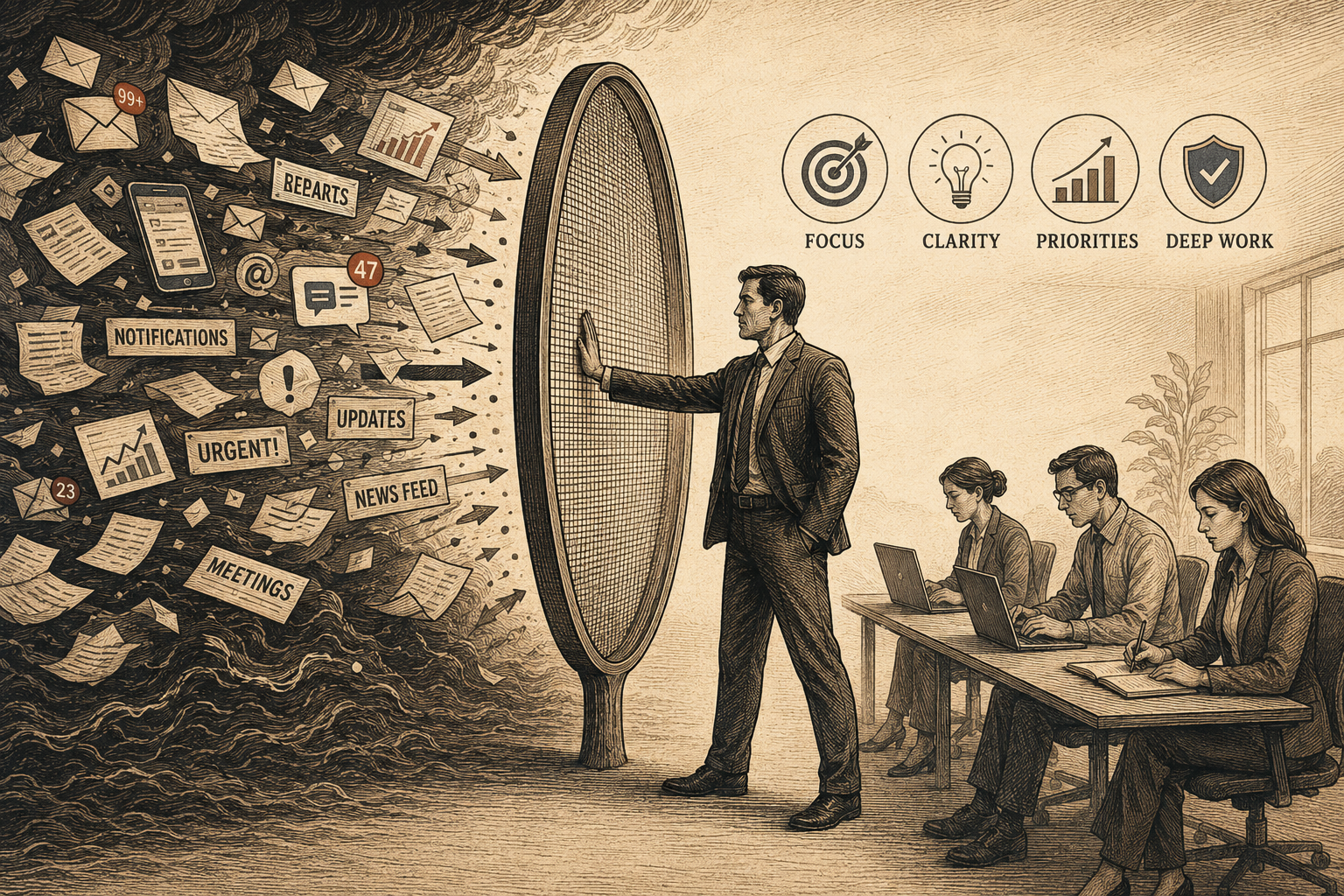
In this environment, the modern leader can no longer function simply as a funnel through which information continuously flows. The leader’s value increasingly depends on becoming a filter, someone who protects clarity, preserves focus, and ensures that teams engage only with information that truly matters.
This is the emerging discipline of boundary leadership. In many ways, boundary leadership is becoming a response to the growing complexity of digital organizations.
Boundary leadership recognizes that human attention is finite. Instead of maximizing communication volume, boundary leadership focuses on protecting clarity, reducing cognitive overload, and preserving the conditions necessary for meaningful work.
Why Information Overload Is Becoming a Leadership Problem
As we witness, the digital economy has dramatically increased the speed of communication. Information that once moved across organizations over days or weeks now moves instantly across global teams.
While this acceleration improves responsiveness, it also creates a hidden organizational cost.
Many professionals now spend large portions of their day processing communication instead of performing meaningful work. Employees continuously switch between emails, messaging applications, project updates, meetings, and operational alerts. The result is fragmented attention and declining cognitive depth.
This is not simply an operational issue. It is a leadership issue.
When leaders forward every update, include teams in every discussion, and expose employees to every external fluctuation, they unintentionally increase organizational noise. Thereby, teams lose the ability to distinguish between urgent information and important information. They can not separate these from background distraction.
As the time passes on, over time, this creates a culture of continuous partial attention, where people remain mentally busy without achieving deep concentration.
In earlier business environments, access to information created competitive advantage. In modern environments, the ability to filter information creates competitive advantage.
The Shift from Funnel Leadership to Boundary Leadership
We observed that historically, traditional leadership models rewarded throughput.
Managers demonstrated effectiveness by increasing visibility, accelerating communication, and ensuring information flowed rapidly across the organization. This situation created the “funnel leader”, who is someone who continuously transfers data downward through the organizational structure.
In highly complex digital systems, however, this approach creates overload.
Every unnecessary message, meeting invitation, copied email, or reactive update consumes cognitive bandwidth. Teams become trapped in reactive workflows where attention is continuously interrupted before deep thinking can occur.
The filter leader operates differently.
Instead of maximizing communication volume, the filter leader optimizes clarity. Their role is not simply to pass information forward, but to synthesize, prioritize, and contextualize it before it reaches the team.
This represents a profound shift in the philosophy of leadership.
The modern leader is increasingly valuable not because they expose teams to more information but because they protect teams from unnecessary complexity.
How Boundary Leadership Protects Focus in the Attention Economy
The rise of the attention economy has transformed focus into one of the most valuable organizational resources.
Technology platforms compete aggressively for human attention. Notifications, instant communication tools, and algorithm-driven engagement systems continuously interrupt concentration. Employees operate inside environments where distraction has become normalized.
Yet meaningful work still depends on uninterrupted thought.
Innovation, strategy, problem-solving, analysis, and creative thinking require sustained mental continuity. Research on deep work repeatedly shows that even brief interruptions can significantly reduce cognitive performance and extend the time required to return to full concentration.
This attention starvation creates one of the defining leadership responsibilities of the modern era: protecting focus.
The filter leader acts almost like a cognitive firewall. They recognize that every interruption carries a hidden switching cost. Instead of demanding immediate engagement with every issue, they create boundaries around attention.
This may include many aspects, inter alia, reducing unnecessary meetings and encouraging asynchronous communication. These help us consolidate updates and create uninterrupted work blocks that helps shield teams from short-term volatility
In many organizations, the most productive teams are no longer the busiest teams. They are the teams whose attention is protected most effectively.
The Hidden Psychological Cost of Constant Noise
Information overload affects more than just productivity. It also affects psychological stability of the people.
When employees are continuously exposed to shifting priorities, market anxieties, internal uncertainty, and reactive communication, they gradually lose their sense of control over their work environment.
This creates severe cognitive fragmentation in functioning of the brain.
People begin operating in permanent reactive mode, as they are constantly responding to signals without enough time to process them properly. As a result, their decision quality weakens, emotional fatigue increases. They increasingly find it difficult to concentrate on strategic thinking.
Over time, this environment contributes to burnout in modern professionals.
However, one of the least discussed responsibilities of leadership today is emotional filtration. Leaders must decide not only what information teams need operationally, but also how much instability teams can absorb without losing vision clarity and self confidence.
This does not mean they are hiding reality. The new concept of boundary leadership is not about secrecy. Rather, it is more of a contextual leadership.
The ‘filter leader’ provides perspective, interpretation, and prioritization so that employees interact primarily with variables they can meaningfully influence.
This restores psychological stability inside complex organizations.
Why Deep Work Is Becoming a Strategic Advantage
As communication volume increases globally, deep work becomes increasingly rare.
This scarcity creates value of deep work.
Organizations that can preserve environments for concentrated thought may gain significant long-term advantages in terms of innovation and strategic thinking. This positive impetus helps them in product development, problem-solving, and decision quality.
In many industries, competitive advantage now depends less on access to information and more on the ability to process information intelligently.
This is why boundary leadership matters.
Leaders who constantly interrupt teams may unintentionally weaken the very intellectual capability they are trying to accelerate. In contrast, leaders who protect deep work create conditions where higher-quality thinking becomes possible.
The future of organizational performance may therefore depend heavily on cognitive architecture. This is the systems leaders create around human attention.
The Role of AI in Information Overload
Artificial intelligence introduces another layer to this challenge.
AI dramatically increases the speed at which organizations generate information. Reports, summaries, recommendations, forecasts, and communication outputs can now be produced almost instantly.
While this improves operational efficiency, it also risks flooding organizations with even more data.
Without intelligent filtering, AI can unintentionally amplify cognitive overload instead of reducing it.
This means the modern leader must increasingly manage both the information flow and AI-generated complexity.
The future leader will not simply oversee people and technology separately. They will orchestrate human attention within increasingly intelligent digital ecosystems.
This is one of the reasons why human judgment is becoming more valuable in the AI era.
What Boundary Leadership Looks Like in Practice
Boundary leadership is ultimately about intentional communication.
The filter leader asks a few questions:
- Does the team need this information now?
- Is this actionable?
- Does this improve clarity or create confusion?
- Does this deserve interruption?
This creates a transition from passive forwarding to active synthesis.
Instead of forwarding every article, message, or update, effective leaders increasingly provide data interpretation, decision prioritization. They help the team in strategic framing of the context.
Some organizations now implement practical structures to support this approach. This includes meeting-free focus periods, structured update windows, and focused decision channels.
These systems recognize an important truth: attention is finite and utmost important.
The most effective organizations are not necessarily those with the most communication. They are often those with the clearest communication boundaries among teams and hierarchies.
What This Means for Young Leaders
For emerging leaders, like you, boundary leadership represents a critical mindset shift.
Earlier generations of managers were trained to maximize visibility and constant engagement. Modern leaders increasingly need the opposite capability: disciplined filtration.
Therefore, young leaders must learn:
- when to communicate and when not to communicate
- what deserves escalation and what deserves silence
- how to protect team cognition, and
- how to preserve clarity amidst complexity
In many ways, leadership today is becoming less about controlling people and more about managing their attention.
The leaders who succeed in the coming decade may not be those who move information fastest, but those who create the clearest environments for focused execution and intelligent thinking.
A New Definition of Leadership Value
The emerging digital economy has changed the meaning of organizational effectiveness.
Earlier leadership models rewarded communication volume, visibility, and continuous activity. On the contrary, modern environments increasingly reward clarity, synthesis, and cognitive protection.
This changes the definition of leadership itself.
The modern leader is no longer simply a distributor of information.
They are rather a a curator of priorities and by that way they are a protector of attention. They are becoming managers of cognitive bandwidth, who can stabilize complexity in the work environment.
Key Takeaways
Therefore, we find a pattern to emerge from here.
- Modern organizations increasingly suffer from information overload rather than information scarcity.
- There the leaders who continuously forward information may unintentionally reduce team focus and productivity.
- On the other hand, boundary leadership emphasizes filtering, synthesis, and cognitive protection.
- In their presence, deep work and uninterrupted concentration are becoming strategic organizational advantages.
- Nonetheless, AI may increase information complexity, making human judgment even more important.
- Therefore, the future leader must protect clarity, attention, and psychological stability inside complex systems.
Closing Thought
The modern workplace is filled with signals competing for attention.
Messages arrive continuously. Updates never stop. Information expands faster than human cognition can comfortably absorb.
In this environment, leadership is no longer defined by how much information a leader can distribute.
As organizations become more connected and information-rich, boundary leadership may become one of the defining management philosophies of the modern workplace.
It is increasingly defined by how wisely they decide what can be ignored.
Visit for more idea and opinions: hbr.org/2022/04/a-guide-to-setting-better-boundaries