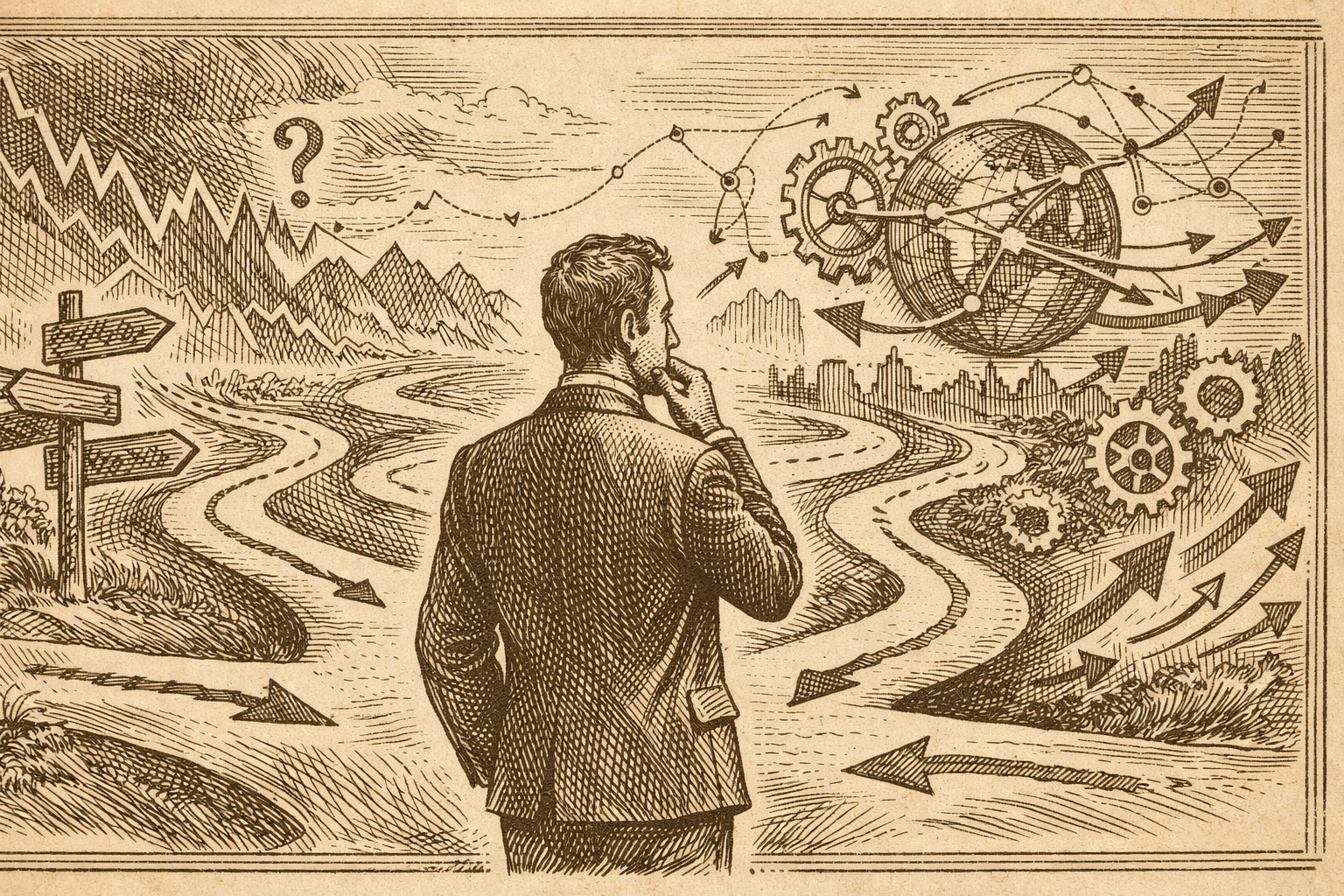
As we are all taught in out schools, for much of the past, leadership was associated with clarity. Leaders were expected to assess available information, weigh alternatives, and choose a direction with confidence. While taking decisions were never an easy task, the environment in which they were made was comparatively more stable, rather more predictable.
Today, many leaders find decision-making more difficult than ever—despite having access to more data, tools (AI), and analytical capabilities than previous generations. This is not a failure of leadership skill. It is a reflection of how the decision environment itself has fundamentally changed over recent times.
The Paradox of Modern Leadership
Modern leaders operate with unprecedented advantages. Real-time data flows, advanced analytics, artificial intelligence, and instant communication were expected to reduce uncertainty and improve outcomes.
Yet the opposite experience is becoming common. Decisions feel heavier, slower, and riskier. Confidence is harder to sustain, and second-guessing has become routine.
The paradox lies here: more information has not translated into more certainty.
Uncertainty Is No Longer Episodic — It Is Structural
In earlier decades, uncertainty often arrived in waves. Economic downturns, geopolitical crises, or industry disruptions were followed by periods of relative stability.
Today, uncertainty has become structural. Economic pressures, geopolitical tensions, technological disruption, regulatory shifts, and social expectations are unfolding simultaneously. Leaders are no longer responding to isolated events but to overlapping forces without clear resolution cycles.
In such an environment, decisions cannot rely on historical patterns alone. Assumptions expire faster, and long-term predictability has weakened.
More Data, Less Clarity
The availability of data has increased dramatically, but clarity has not kept pace.
Leaders today face conflicting indicators from multiple sources
- Short feedback loops that amplify noise
- Metrics that explain outcomes after the fact but rarely guide judgment beforehand
Data informs decisions, but it does not remove responsibility. When signals conflict, leaders must still decide which inputs matter most. With increased data supply and related information, this judgment burden has increased—not decreased.
How AI Has Changed the Nature of Judgment
The inherent disclaimer that says AI can make mistakes, makes the workflow short of absolute acceptance.
Artificial intelligence adds another layer of complexity. AI systems excel at identifying patterns, generating options, and optimizing processes. But they do not assume accountability. Moreover, the inherent disclaimer that says AI can make mistakes, makes the workflow short of absolute acceptance.
AI can suggest actions, but it cannot absorb the consequences of those actions. Responsibility still rests with human leaders.
As AI becomes more embedded in decision workflows, leaders face a subtle challenge: distinguishing assistance from authority. When algorithmic recommendations conflict with human intuition, the decision becomes harder, not easier.
Judgment has shifted from choosing between options to deciding how much trust to place in automated intelligence.
Policy and Regulation as Compounding Factors
Decision-making complexity is further amplified by evolving policy and regulatory environments.
Policies are often well-intentioned, but execution gaps, delayed clarity, and inconsistent enforcement create uncertainty for organizations. Leaders must anticipate regulatory shifts while operating without complete guidance.
This uncertainty does not just affect compliance—it shapes investment, hiring, and long-term strategy. Decisions are increasingly made under conditions where rules may change after commitments are made.
The Decision-Making Load Has Changed
What leaders are deciding today is fundamentally different from the past.
Decisions now involve longer consequence chains, ethical and reputational implications, cross-border effects, and public scrutiny amplified by digital platforms
Leadership is no longer about selecting the optimal option from a known set. It is about navigating trade-offs where no option is clearly right.
This is not indecision. We may refer it as contextual complexity. This growing complexity is also driving a broader shift in leadership, where traditional control-based approaches are giving way to more adaptive models.
The New Decision Environment for Leaders
A useful way to understand today’s leadership challenge is to recognize how the decision environment has shifted.
We can clearly see fewer decisions have clear answers. The trade-offs are more visible and contested. The outcomes of decisions are harder to measure in the short term. We also have seen decision-making errors carry broader consequences.
In such an environment, decisiveness alone is no longer a sufficient leadership trait. Decision interpretation, decision coherence, and workflow adaptability matter more in real life organizations.
What Effective Leaders Are Doing Differently
A quick look at the present decision making scenarion reveals that leaders who navigate uncertainty effectively are not trying to eliminate it. Instead, they are adjusting the very process of how decisions are made.
There we see some common patterns. They include, slowing down irreversible decisions while accelerating reversible ones. This means decentralizing and overhauling operational choices while centralizing the very principles that govern it.
Another aspect is using AI as input for all data analysis and prediction purposes, but they seldom accept that as final authority.
And finally, great leaders always create some buffers layers in their decision making process for learning and course correction requirements in unpredictable future.
Rather than seeking certainty, these leaders design systems that can absorb uncertainty.
From Control to Coherence
We notice historically that the traditional leadership ideals emphasized control. They tried to predict outcomes and directed decisions for execution. In an uncertain environment, this model struggles.
What replaces it is coherence. Here the aspect of coherence refers to some dimensions. It refers to aligning people around shared principles and visions. This demands maintaining long-term direction, even when short-term tactics change.
Therefore, as it evolves, organizational leadership today is less about just knowing the right answer. As it seems, it is more about holding the organization together while answers evolve.
Key Takeaways
- Decision-making is harder today because the environment is more complex, not because leaders are less capable.
- Uncertainty has become structural rather than temporary.
- More data and AI tools increase options but also increase judgment responsibility.
- Policy, technology, and global forces compound decision risk.
- Effective leadership now depends on coherence, adaptability, and principled judgment.
In an age of uncertainty, leadership is not about eliminating doubt.
It is about making thoughtful decisions despite it.