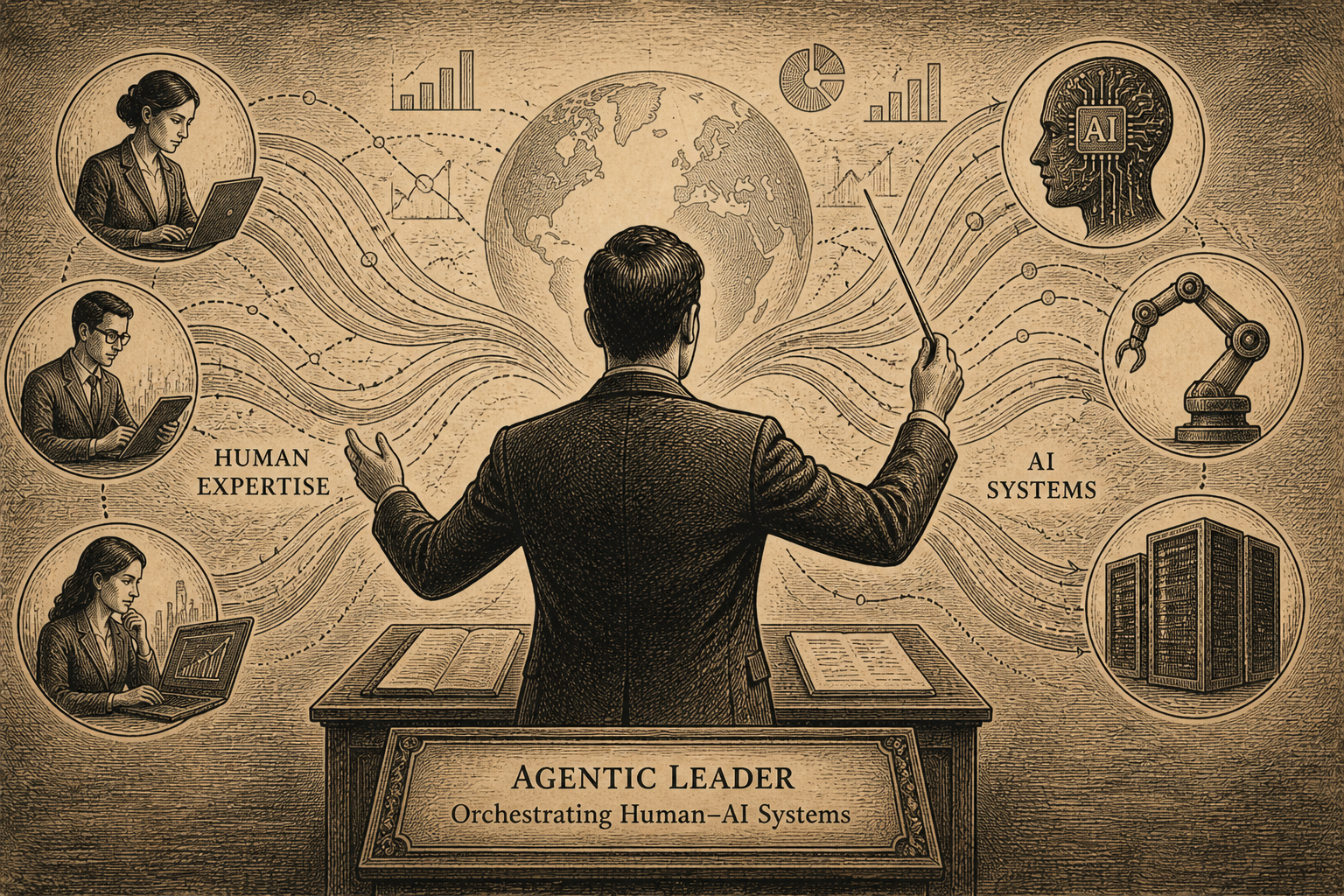
Human AI leadership is becoming central to how organizations operate in a volatile world. If we review the trend for over the past few years, much of the conversation around artificial intelligence has focused on its potential.
Today, that conversation has moved forward. Human AI leadership is reshaping the future of organizations through deeper human machine collaboration and more adaptive decision-making systems.
The clear trend is that the organizations are no longer experimenting with AI as a support tool. They are increasingly integrating systems that can execute tasks, coordinate workflows, and also operate with a degree of autonomy. These systems do not simply respond, they act within defined objectives.
At the same time, global markets are becoming more volatile. Energy shocks, regulatory changes, and geopolitical tensions are creating conditions where decisions must be made quickly, often with incomplete certainty.
In this environment, the one that is changing that is leadership.
The role of the leader is no longer centered on individual decision-making alone. It is increasingly about coordinating a system where human judgment and machine capability interact continuously. And thus the human AI leadership becomes important.
From Tool Usage to Human AI Leadership Systems
In the early phase of AI adoption, organizations used technology in a limited and supportive manner.
In general, tools were applied to 1] summarize information, 2] automate basic tasks, and 3] assist in routine workflows. However, the artificial intelligence still cannot do many things, and that matters.
We notice that this phase improved efficiency but did not fundamentally change how organizations operated, as Hhuman AI leadership was yet to take shape.
That is beginning to shift to the human AI paradigm. We can only expect that the human AI remationship will be intense in leaps and bound.
What we see is the organizations are now integrating multiple AI systems into coordinated workflows, where different components handle different parts of a process.
In corporate spaces, in areas such as procurement, software testing, and customer operations, many organizations are deploying interconnected systems, that can manage entire processes which require minimal intervention. In this context, the human oversight remains focused on exceptions and decision points.
Here the transition is from using tools to managing systems.
Redefining the Human Contribution
As technology absorbs routine and repetitive tasks, the nature of human work is becoming more concentrated, and agentic responsibilities are coming into focus.
While some of the execution of the AI is done by AI engines, what remains with humans is not execution alone but interpretation, judgment, coordination, and ethical decision-making as mandated by the use of AI framework. .
In financial and operational functions, AI systems may generate multiple scenarios and recommendations, but final decisions, especially those involving trade-offs, continue to rely on human evaluation.
The value of human work is shifting from doing tasks to defining direction. Our human capability is becoming the ultimate advantage. In the coming days, the evolving metric for the future for human performance measurement will evolve around how strong you are in human-machine collaboration, how adept you are in decision-making, and how efficient your AI leadership is.
Small Teams, Expanded Capability
One of the most visible outcomes of this shift is the change in team structure.
Organizations are increasingly operating with smaller human teams supported by advanced systems. These teams are able to manage a much larger scope of work than before. As the AI leadership is evolving every day, this will be the norm of the future.
A small group of professionals can now oversee operations that previously required significantly larger teams by coordinating technology-enabled processes across multiple functions.
As it is evident here, the scale is no longer determined only by the number of people.
It is determined by how effectively human capability is combined with technological systems.
Speed in a Non-Linear Environment
Historically, we have noticed that modern business environments are characterized by rapid and often unpredictable changes.
Even events of one region can quickly affect supply chains, energy prices, and financial markets elsewhere and make them volatile. The speed at which information travels has increased, and so has the speed at which organizations must respond.
Organizations increasingly use real-time data to adjust sourcing, logistics, and pricing decisions in response to market changes, often within very short time frames.
Faster information requires faster interpretation, but not necessarily faster conclusions.
The challenge is not only responding quickly, but responding appropriately.
The Growing Importance of Context and Judgment
While systems can process data at scale, they do not fully account for context.
They may identify patterns, generate predictions, and optimize outcomes within defined parameters. However, they do not fully understand the aspects of 1] the eventual broader consequences, 2] the social impact, as a result, and 3] corresponding ethical considerations
In areas such as compliance, environmental impact, or strategic partnerships, decisions often involve factors that extend beyond measurable data.
Data can help confirm decisions. However, it cannot define responsibilities therein.
The Accountability Question
One of the most important challenges in this evolving system is accountability.
As decision-making becomes more distributed between humans and machines, responsibility does not disappear; it becomes more complex.
Organizations are increasingly required to explain and justify decisions influenced by automated systems, particularly in regulated industries.
The responsibility for outcomes remains with leadership, regardless of how decisions are generated.
Managing Cognitive Load
As systems generate more outputs, the role of the human shifts toward reviewing, validating, and interpreting.
This can create a different kind of pressure. Instead of performing tasks directly, professionals must 1] monitor systems, 2] evaluate outputs, and 3] remain alert to anomalies.
Organizations are beginning to assess whether technological tools are reducing workload or simply redistributing it, particularly in knowledge-intensive roles.
Efficiency gains must be measured not only in output, but in mental clarity.
Leadership in an Integrated System
In this evolving environment, leadership is becoming less about control and more about alignment.
Leaders must integrate human and technological capabilities to ensure clarity of objectives and maintain ethical and strategic direction.
A Defining Idea
Therefore, leadership is no longer about doing more or knowing more. It is about ensuring that systems, both human and technological aspects, work together effectively. The control itself is giving way to adaptation in leadership.
What Human AI Leadership Means for Young Leaders
For emerging leaders like you, this shift is significant. Your success in coming days will depend on your ability to interpret complex systems. You must be comfortable with uncertainty. Besides that, you must possess the ability to balance speed with judgment. And you must understand the broader environment in which decisions are taken.
Therefore, there is a clear advantage, which lies not in controlling systems, but in understanding how they interact with each other.
A Changing Leadership Model: Human AI Leadership in a Volatile World
As we see that the emerging model is in stark contrast to the earlier model. Below we tried to summarize the principal aspects of these two models.
| Earlier Model | Emerging Model |
| Task supervision | System coordination |
| Individual decision-making | Distributed decision processes |
| Information control | Information interpretation |
| Stability-focused | Adaptability-focused |
What we notice is the earlier model was built for control, these are clear tasks, centralized decisions, and stable environments. The emerging model is built for complexity, these are coordinated systems, distributed decisions, and constant change.
We also notice that the leaders are no longer valued for managing information or enforcing structure, but they are valued more for interpreting signals, aligning diverse elements, and adapting quickly in uncertain conditions.
Key Takeaways
- Organizations are moving from tool-based AI use to integrated systems.
- Human roles are shifting toward judgment, interpretation, and coordination.
- Smaller teams are managing larger scopes of work through technology.
- Speed of decision-making is increasing but requires careful interpretation.
- Accountability remains with leadership, even in automated systems.
- Managing cognitive load is becoming a critical leadership responsibility.
Closing Thought
Technology is changing how work is done. But the essence of leadership remains critically important. In a system shaped by intelligent machines, the defining factor is still the quality of human judgment.