The Experience Trap:
Executive Insight: Why the Experience Trap Is Reshaping Modern Leadership
We notice an important shift in our corporate experience.
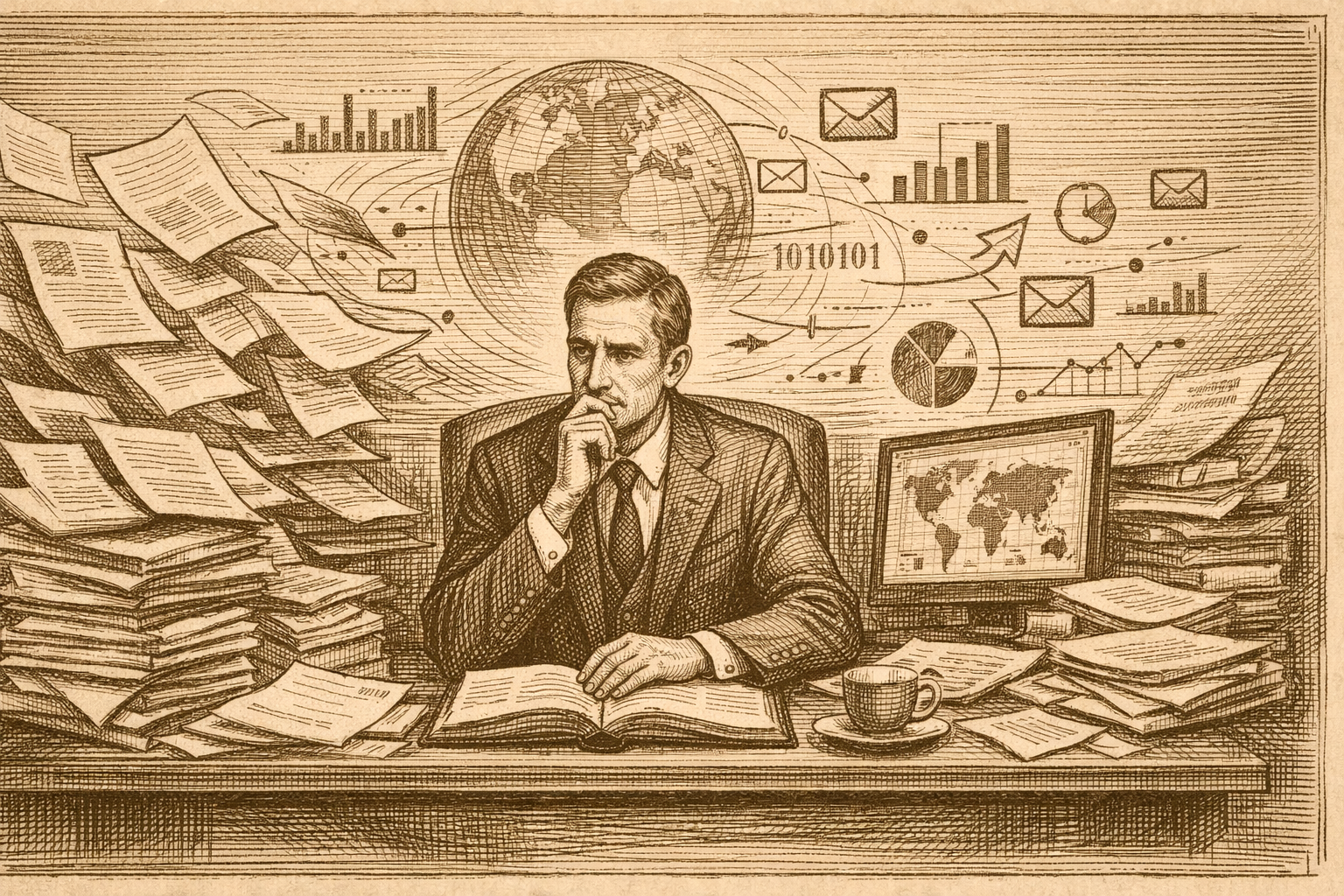
The so-called experience trap is becoming one of the defining leadership challenges of the modern economy. For decades, we have treated professional experience as an appreciating asset that increases its asking value over time. Leaders spent years mastering an industry. As a result, they develop authority, strategic confidence, and institutional value. Organizations rewarded accumulated expertise because historical knowledge was adjudged to be improved decision-making, operational efficiency, and long-term decision-making.
Today, however, the stability of expertise is beginning to weaken.
Across the industries, present leaders are noticing that their knowledge no longer remains relevant for as long as it once did before. They need to protect focus in overloaded organizations. As the technologies evolve rapidly, industries reorganize continuously.
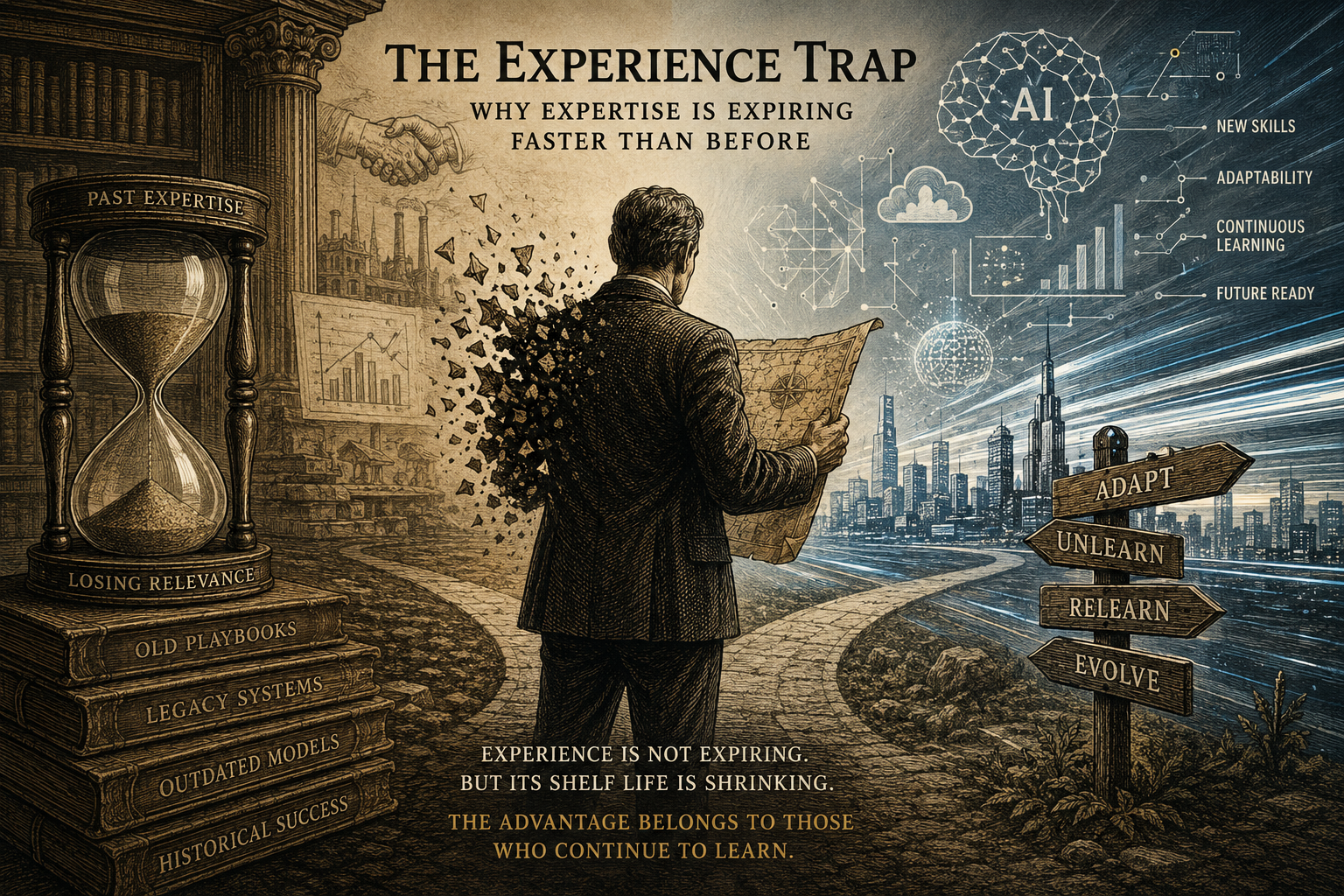
Also in present time, the use of artificial intelligence is accelerating the speed at which professional skills become outdated fast. Experience still matters deeply, but its usable lifespan is shrinking.
This is the emerging experience trap.
The problem is not that experienced professionals lack intelligence or capability. The problem is that markets, technologies, and organizational systems are now changing faster than historical expertise can comfortably adapt.
In this environment, relying exclusively on old playbooks can quietly become a strategic liability.
As organizations move deeper into the AI economy, the ability to continuously relearn may become more valuable than the comfort of accumulated certainty.
Why the Experience Trap Is Becoming a Strategic Risk
The experience trap emerges when historical success creates psychological attachment to outdated assumptions.
For years, professionals built careers around stable systems. However, markets changed gradually, technologies evolved slowly, and organizational structures remained relatively predictable. In that environment, accumulated expertise created a durable advantage.
Needless to say that the modern business environments operate differently.
Today, industries experience continuous disruption from many emerging aspects. These may include, all powerful artificial intelligence, automation everywhere, digital transformation across the sectors, geopolitical instability, changing workforce models and lastly the shifting consumer behaviour.
As it is shifting to a new paradigm, as external systems evolve more rapidly, experienced professionals may unconsciously interpret major structural changes as temporary disruptions rather than permanent transformations.
This creates what organizational theorists often describe as path dependency. This is a tendency to rely on historical frameworks, just because they worked successfully in the past times.
Here the danger is subtle but significant.
Many leaders who once succeeded through established methods may continue applying those same methods with greater intensity, even when the surrounding environment has fundamentally changed. In such situations, experience itself can unintentionally slow down the adaptation process.
Therefore, the very expertise that once created competitive advantage may eventually become the mechanism that limits organizational evolution.
How Technological Acceleration Is Shortening the Half-Life of Knowledge
One of the most important drivers of the experience trap is the rapid acceleration of technological change.
The modern economy operates through compressed knowledge cycles. Earlier generations learned systems that often remained relevant for decades. Today, professionals continuously relearn tools, platforms, and workflows throughout their careers.
This phenomenon is increasingly described as the shortening half-life of knowledge.
In many technical and strategic fields, professional expertise now depreciates much faster than before. Software ecosystems evolve continuously, AI systems automate established processes, and digital platforms reshape industries almost overnight.
The implications extend far beyond technology companies. As organizations integrate intelligent systems more deeply, human AI leadership is becoming increasingly important for balancing technological speed with human judgment.
The sectors like, Manufacturing, healthcare, logistics, finance, education, consulting, and media are all experiencing rapid structural transformation driven by rapid implementation of intelligent systems and digital integration.
As a result we notice that the value of static expertise is weakening.
Now a days, we also notice that the organizations are increasingly placing greater emphasis on systems thinking, learning agility, cross-functional understanding, adaptive problem-solving and technological fluency.
The associated premium is shifting away from simply knowing how to execute a fixed task. And at the same time, rather increasingly, value belongs to professionals who understand how evolving systems interact dynamically.
The Experience Trap and the Competency Trap
The experience trap becomes even more dangerous when organizations fall into what management scholars describe as the competency trap.
A competency trap occurs when organizations become exceptionally efficient at historical ways of operating while gradually losing the ability to adapt to new realities.
This often happens because established systems continue producing short-term results. Leaders naturally focus on refining existing competencies, optimizing known processes, and maximizing efficiency within familiar business models.
This is the logic of exploitation.
At the same time, organizations frequently underinvest in exploration. They experiment with uncertain models and test unfamiliar technologies. They also challenge established assumptions and develop future capabilities.
The problem is that exploitation creates stability only within environments that remain relatively constant.
When industries shift rapidly, organizations overly dependent on historical competence may become strategically fragile. New competitors often adapt faster precisely because they are not burdened by protecting legacy systems, outdated infrastructure, or deeply institutionalized assumptions.
History repeatedly demonstrates this pattern.
Many times, it is observed that large organizations rarely fail because they suddenly lose all capability. More often, they fail because they become too optimized for a world that no longer exists.
Why Adaptive Intelligence Is Replacing Static Expertise
Industries are becoming more fluid. And so organizations increasingly value adaptive intelligence over static expertise alone.
We need to learn more about Adaptive intelligence. It refers to the ability to learn continuously and absorb unfamiliar concepts rapidly. This is all about revising mental models and navigating uncertainty to integrate emerging technologies and transfer knowledge across changing systems.
This represents a profound shift in professional identity that we know.
Earlier career systems rewarded specialization, predictability, and procedural mastery. In contrast, modern economies increasingly reward flexibility, curiosity, and learning velocity.
In many organizations today, the most valuable professionals are not necessarily those who possess the most historical knowledge. They are often the individuals who can learn quickly and help evolve smoothly with the emerging situations. They synthesize new information quickly and operate effectively amidst procedural and role uncertainty.
The future increasingly belongs to professionals capable of continuous reinvention without losing strategic judgment.
Why Experienced Professionals Feel Increasingly Uncertain
One of the least discussed consequences of the experience trap is psychological.
Many experienced professionals quietly feel increasing uncertainty in rapidly evolving industries. They may continue performing effectively while simultaneously sensing that the systems surrounding their expertise are changing faster than expected.
This creates a form of invisible instability. This constant pressure to relearn and adapt is also contributing to a broader silent productivity crisis across modern workplaces.
A leader may possess decades of experience while feeling uncertain about many present day jargon, such as, AI integration, evolving workforce models, digital transformation, platform economics, changing consumer behaviour, and technological disruption
This explains why conversations around reskilling, upskilling, continuous learning and career reinvention have become increasingly central inside modern organizations.
So we can safely say that the modern challenge is no longer simply acquiring expertise.
It is maintaining relevance in environments where relevance itself changes continuously.
How Organizations Can Escape the Experience Trap
This part is tricky. Escaping the experience trap requires organizations to move from static expertise toward dynamic capabilities.
These dynamic capabilities refer to the ability of organizations to continuously integrate, reconfigure, and update internal competencies in response to changing external conditions.
This requires a different organizational mindset. Many companies now recognize that business growth is being redefined around resilience, adaptability, and long-term sustainability.
Leaders must encourage systems that regularly challenge existing assumptions instead of automatically reinforcing historical practices. One of the most effective approaches involves adopting double-loop learning.
Traditional problem-solving focuses on improving execution within existing assumptions:
Are we doing things correctly?
However, double-loop learning asks a much deeper question:
Are our underlying assumptions still valid?
This distinction is critical.
Organizations trapped in outdated mental models often optimize declining systems instead of adapting to emerging realities. In contrast, organizations that continuously question foundational assumptions maintain greater strategic flexibility.
We notice that modern leadership increasingly requires intellectual humility alongside operational expertise.
Building a Learn-It-All Organization
The operational solution to the experience trap is creating what many modern organizations now describe as a “learn-it-all” culture instead of a “know-it-all” culture.
In highly dynamic economies, sustainable advantage increasingly depends on learning velocity rather than static knowledge accumulation.
Organizations can strengthen learning adaptability through several practical mechanisms.
First, leadership teams should regularly conduct strategic assumption reviews where legacy processes are reassessed based on current market realities rather than historical precedent.
Second, organizations should create controlled experimentation systems that allow teams to test unfamiliar ideas without excessive bureaucratic resistance.
Third, reverse mentorship structures can become highly valuable. Younger professionals often possess stronger familiarity with emerging technologies, digital ecosystems, and shifting consumer behaviours. Pairing experienced executives with younger technical talent creates faster organizational learning cycles.
Finally, organizations must normalize unlearning.
In many cases, long-term success now depends not only on learning new capabilities, but also on consciously abandoning outdated assumptions.
What the Experience Trap Means for Young Leaders
For emerging leaders, the experience trap offers an important lesson about the future of professional relevance.
Success will increasingly depend not only on accumulating expertise, but also on maintaining the ability to continuously reinterpret expertise within changing systems.
Young leaders must avoid becoming psychologically fixed around single skill sets. They should come out of static business models with rigid career identities and outdated technological assumptions.
Instead, modern leadership requires a few qualities such as, curiosity, adaptability, systems thinking, technological awareness and continuous learning discipline.
The strongest professionals of the next decade may not be those who possess the most knowledge today.
They may be the ones who can continue evolving most effectively even tomorrow.
The Emerging Shift in Professional Value
We find that a new shift is emerging. Below we note its characteristics in contrast to the earlier model.
| Earlier Model | Emerging Model |
| Experience creates stability | Adaptability creates resilience |
| Expertise remains durable | Knowledge expires faster |
| Static professional identity | Continuous reinvention |
| Efficiency through repetition | Agility through learning |
| Institutional memory | Dynamic capabilities |
Key Takeaways
- The experience trap occurs when historical expertise slows adaptation to changing environments.
- Technological acceleration is shortening the half-life of professional knowledge.
- Organizations trapped in old competencies become vulnerable during structural shifts.
- Adaptive intelligence and learning velocity are becoming critical professional advantages.
- Double-loop learning helps organizations challenge outdated assumptions.
- The future belongs to professionals who combine experience with continuous reinvention.
Closing Thought
Experience still matters deeply.
But experience alone no longer guarantees relevance.
In an economy shaped by artificial intelligence, technological disruption, and continuous transformation, the strongest professionals may not be those who simply know the most about the past.
They may be the ones most willing to continuously learn the future.