Across the world public policies across countries are usually introduced with genuine and well-defined intentions. They are designed to solve social problems, stimulate economic growth, strengthen governance, or protect vulnerable groups of the nation. However, historical evidence shows that they share a familiar pattern. Many policies that appear very sound on paper often result in mixed or disappointing results in ground reality.
There lies a clear gap between policy intent and policy outcome. This is not always the result of flawed ideas. While we safely assume that the intention is never wrong, the gap emerges during execution, where complex ground realities, conflicting institutional constraints, and sometimes undesirable human behaviour interplay to shape what is ultimately achievable.
Public Policy — Definition
The term public policy refers to the aggregate decisions, actions, and guidelines that governments or public authorities adopt to address various issues of public concern. Policies are meant to facilitate achieving specific social, economic, or political objectives of their jurisdiction.
Essentially, it includes not only what governments choose to do, but also what they choose not to do. These desired choices are implemented through enacting laws and regulations, running programs, and monitored administrative actions.
In simple terms, public policy is the government’s planned course of action to manage problems and resources of public.
Features of Public Policy
There are a few well-defined characteristics of public policy. We list here their most acknowledged features.
- Authoritative, because they carry legal and institutional backing
- Goal-directed, since they aim at specific outcomes
- Action-oriented, requiring delivery rather than announcement
- High-impact, affecting citizens, markets, and public systems
- Dynamic, often evolving as conditions change over time
The Gap Between Policy Design and Ground Reality
Policy formulation usually takes place in structured environments with contributions from multiple stakeholders. Relevant data is collected, stake holder consultations are conducted, justified assumptions are made, and thoughtful interventions are designed to appear coherent and logical. However, real-world conditions rarely align neatly with these assumptions.
It may be noted that local contexts vary widely in terms of administrative capacity, economic conditions. Their social norms, and available resources also play a significant role. When a policy is designed using information from national averages, those may encounter very different realities at the regional or local level.
As a result, uniform policy frameworks often struggle to accommodate diverse ground-level conditions. Therefore, what looks efficient in intent and design, may become very tough to implement in practice.
Institutional Capacity as a Hidden Constraint
One of the most underestimated factors in policy execution is institutional capacity.
To be effective, implementation of policies requires 1] skilled personnel, 2] their clear roles and accountability, 3] adequate funding for them, and 4] robust monitoring systems for their progress.
In many cases, during execution existing institutions stretch beyond their normal course of actions to shoulder the added responsibilities. From the management’s perspective, usually it is observed that new mandates if introduced without strengthening administrative capacity can create overload to the operating system rather than impact.
Even well-funded policies can struggle if institutions lack coordination mechanisms, necessary personnel training, or decision-making authority.
Real-World Examples of the Policy–Execution Gap
1. Infrastructure Development and Delayed Delivery
Governments across the world frequently announce large-scale infrastructure policies that are aimed to multiple objectives, such as to improve connectivity, boost economic activity, and create jobs. These initiatives must be supported by significant budgetary allocation and long-term strategic planning.
Yet in general policy execution commonly lags behind its designed intent. Policy delays may emerge from many different challenges, such as land acquisition challenges, regulatory clearances, contractor limitations, and lastly, depending on the country and its local areas, coordination failures between central and local authorities.
The result is a familiar gap: expectations rise, capital is allocated, but tangible outcomes arrive slowly and unevenly.
This illustrates that sound policy design often cannot compensate for weak execution capacity and fragmented coordination.
2. Employment and Skill Development Policy and Programs
Many governments introduce employment and skill development policies to address their unemployment and workforce upskilling and re-skilling requirements. These programs aim to equip individuals with relevant skill update that in turn may improve employability.
In practice, implementation of these wide range policies often come across delays. There may be multiple ways that these may face struggles.
| Domain | Possible Reasons |
| Training Curricula | It may not align with industry needs |
| Qualified Trainers | Local institutions may lack qualified trainers |
| Employment | Job placement mechanisms may be weak |
These reasons affect numbers of participants. These may may look strong on paper, but in general, data shows that employment outcomes frequently fall short of policy goals.
These simple aspects show the importance of continuous feedback and monitoring without which labour policies may just become more for compliance, than for outcomes.
Illustrative Patterns Across Policy Domains
Historically, it is observed that in different sectors similar execution gaps emerge. These are repetitive in nature. We list here a few common gaps that exist in policy implementation.
| Policy Area | Intended Objective | Common Execution Gap |
| Infrastructure Development | To improve connectivity and growth | Frequent delays due to approvals and coordination failures |
| Skill Development Programs | To reduce unemployment through training | Often limited placement despite certification |
| Welfare Delivery Systems | To ensure benefits reach eligible groups | Resource leakages, arrival delays, and exclusion errors |
| Environmental Regulation | To balance sustainability and development | Partial plan enforcement and lacklustre monitoring and decision constraints |
| Urban Planning Policies | To manage urban growth effectively | Fragmented execution across agencies |
As we can see here that these patterns reinforce our assumption that implementation challenges are structural, not isolated.
Implementation Gaps and Coordination Challenges
For policy execution works, across different levels of government, multiple agencies typically operate together. A coordination framework is required upfront that helps sustain them in practice, though difficult.
Also, on many occasions, unclear project ownership, their overlapping responsibilities, and fragmented reporting structures slow the entire decision-making process. When problems arise, government agencies often negotiate with roles and responsibilities rather than resolve issues swiftly.
Over time, these coordination failures increase the gap between policy objectives and their intended outcomes.
Why Implementation Is Ultimately a Leadership Challenge
In a leadership classroom, policy execution is often discussed as an administrative issue, but in practice it is equally a leadership challenge. As we have discussed successful policy implementation requires clarity of responsibility, timely decision-making. This also demands the ability to manage competing constraints on the ground.
This is the reason why execution failures are frequently symptoms of leadership gaps, not just technical ones.
The Policy Execution Chain
Yes, there is a useful way to understand implementation gaps. Leaders need to view policy execution as a chain of events. We note here a model that explains the concept.
- Policy Design — objectives and rules
- Institutional Capacity — resources and staffing
- Coordination Mechanisms — alignment across agencies
- Local Adaptation — fit to regional realities
- Accountability Systems — responsibility and incentives
- Outcome Delivery — measurable impact on citizens
As per the weak-link theory, weakness at any link prevents policy intent from becoming real-world outcomes.
This framework helps us explain why policy success is not determined by its design alone.
Why This Matters Beyond Public Administration
As we have discussed here, implementation failures are not confined to government departments alone. The stake-holder businesses adjust their investment decisions based on emerging regulatory effectiveness. However, the citizens judge institutions by ultimate delivery, not mere announcements alone. Businesses often respond by shifting priorities toward financial caution and cash flow stability rather than aggressive expansion.
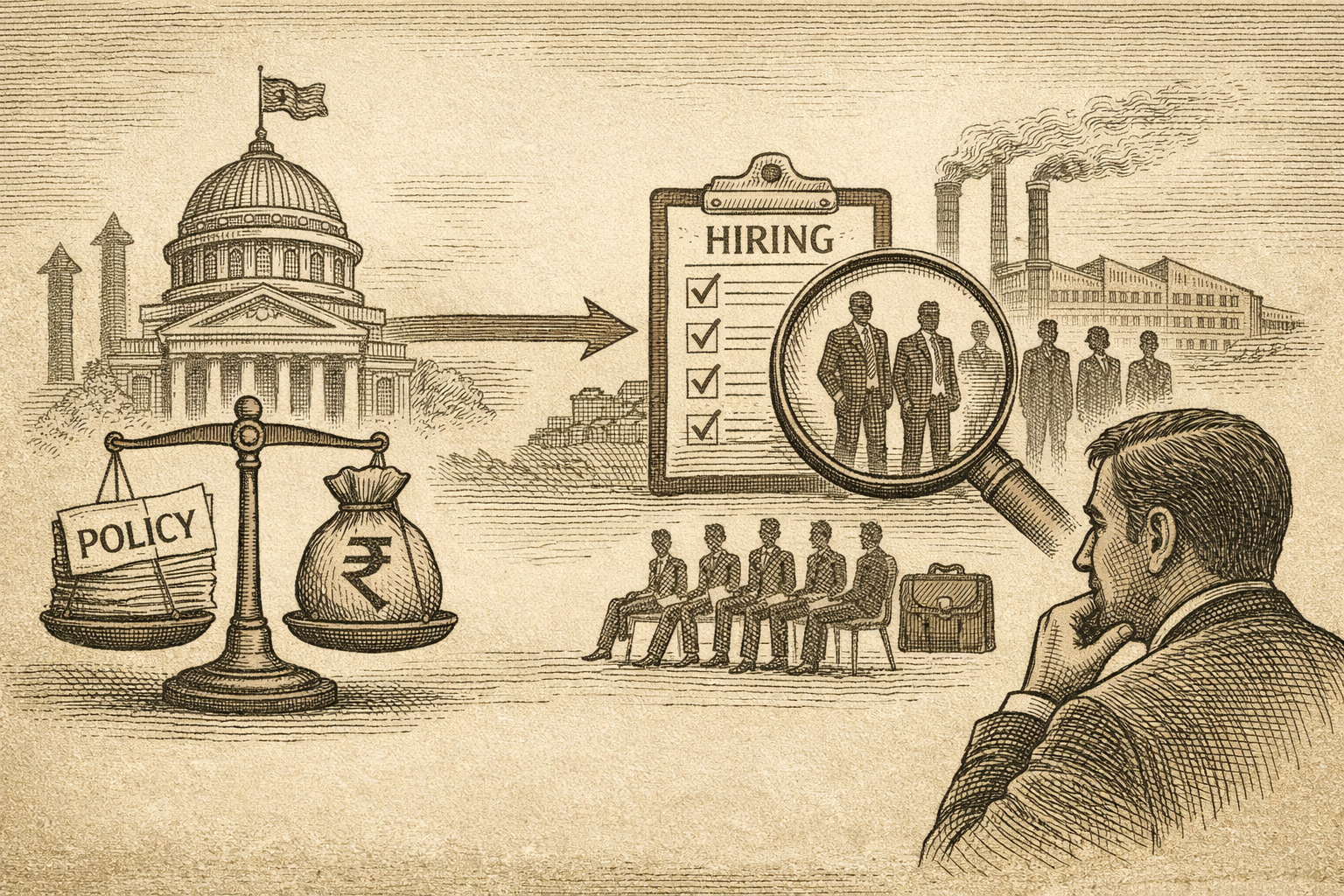
When execution gap surface repeatedly, the trust in public systems erodes. This happens, even when the policy intent is sound. These execution gaps also shape corporate behaviour, including how organizations adjust hiring and workforce planning in response to policy signals.
Therefore, for policymakers, the challenge is not only to design better policies, but also to design for timely execution.
What Effective Governance Does Differently
Here in this context, a question arises. Policies are more likely to succeed when governance systems facilitate the same. We list here a few governing parameters that can work as mantra to help the policies succeed.
- To build execution capacity before scaling programs
- To define accountability clearly across agencies
- To create feedback mechanisms from the ground upward
- To allow local flexibility rather than rigid uniformity
- To measure outcomes, not only activity or compliance for the sake of compliance
We understand that, successful governance treats implementation as a continuous process of learning and adjustment. They do not just treat this as merely administrative rollout.
Key Takeaways
We notice here that well-intentioned policies often struggle not because their objectives are flawed, but because their execution is usually done in complex, resource-constrained environments. Policy implementation becomes even harder in periods of overlapping global pressures and structural uncertainty.
Also, institutional capacity, their team coordination, planned incentives, and system adaptability play a very decisive roles in shaping the outcomes of the policies.
In order to bridging the gap between policy design and ground reality, the policy makers have to treat implementation as a dynamic process, and not merely an administrative step. Ultimately, policy success is measured not by intent, but by sustained impact on the ground.