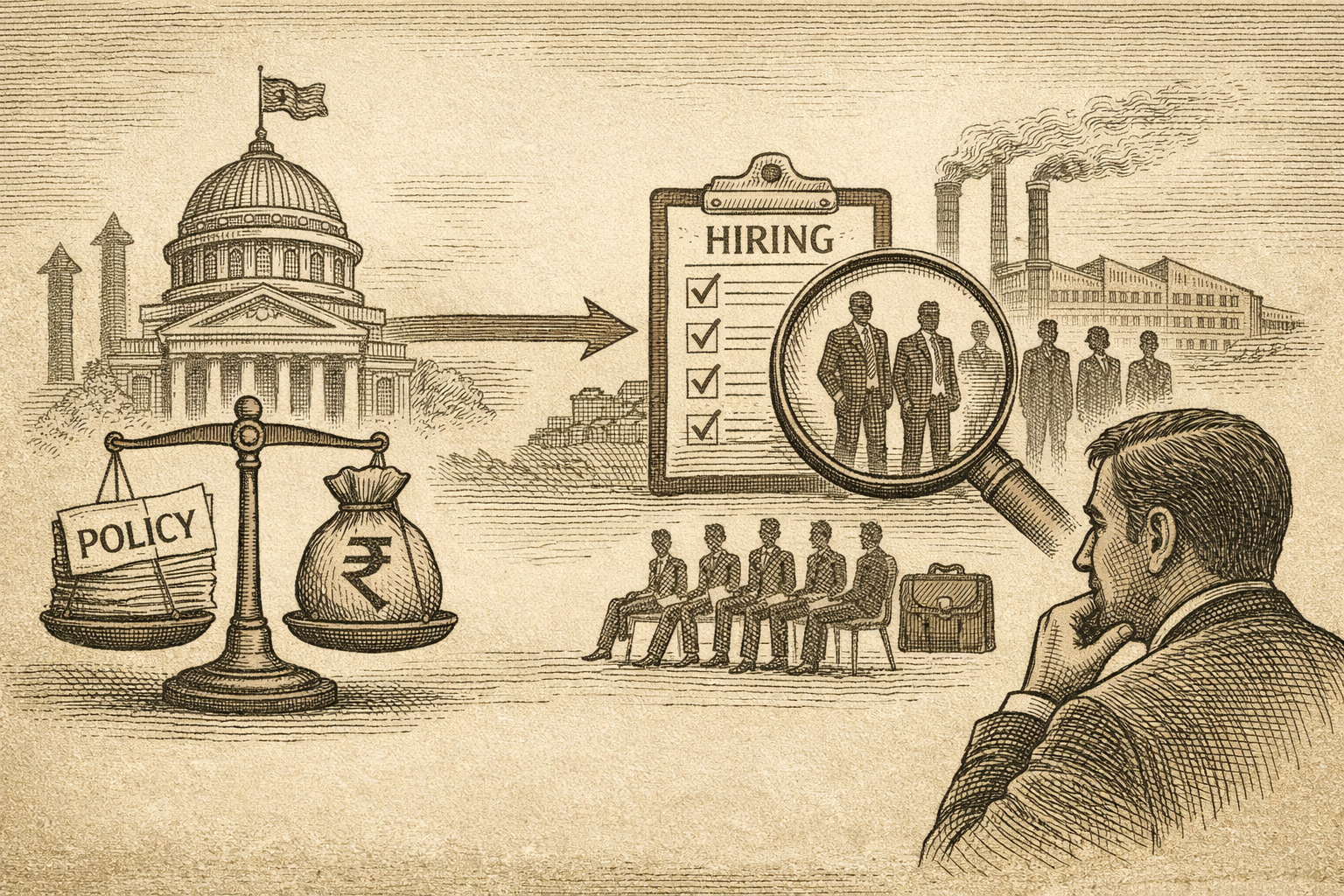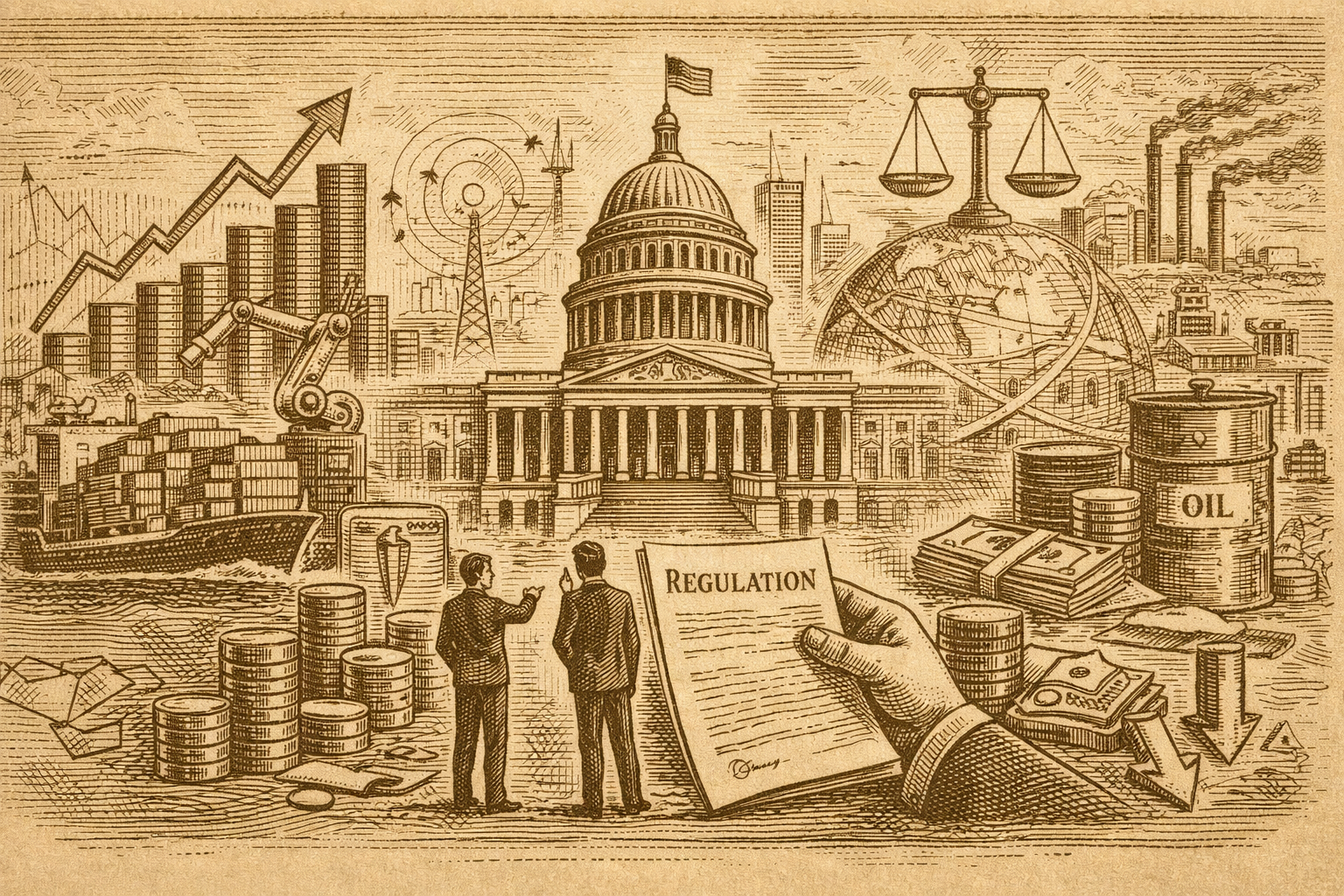
For decades, the global business mandate was simple: efficiency above all. Guided by the “invisible hand” of the market, leaders prioritized lean supply chains and borderless expansion. But in 2026, the pendulum has swung. From the “Essential Minerals Act” to sovereign AI clouds, we are witnessing the return of the Visible Hand—a new epoch where national security, geopolitical resilience, and state-led industrial policy have replaced pure ROI as the primary drivers of the economy.
In this briefing, we break down the three structural shifts redefining the private sector:
- From Efficiency to Sovereignty: Why governments are moving from “referees” of the market to “architects” of strategic industries.
- The Regulatory Squeeze: How the 2026 global compliance landscape has made “Geopolitical IQ” a mandatory leadership trait.
- The Hybrid Future: Navigating the delicate balance between market-driven innovation and state-mandated stability.
In a re-regulated world, your greatest risk isn’t your competition—it’s your lack of alignment with the state’s strategic map.
From Market Efficiency to Strategic Control
Across the horizon, the earlier model of economic governance emphasized efficiency. Open-to-all national markets, competition, and globalization were seen as mechanisms to optimize production and reduce costs.
However, as we have witnessed, efficiency alone does not guarantee stability.
Recent events have revealed vulnerabilities in systems that rely heavily on market-driven outcomes. Governments are increasingly recognizing that certain sectors—such as energy, healthcare, infrastructure, and technology—carry strategic importance that extends beyond economic metrics.
So to say, the “Laissez-faire” era is ending. Governments no longer trust the “invisible hand” to protect national interests.
The 2025 “Essential Minerals Act.”
In a massive shift, several Western governments began directly funding domestic lithium and cobalt mining. They moved from letting the market decide the price to treating these minerals as “Strategic Assets” that cannot be left to global supply and demand alone.
As a result, policy is shifting from enabling markets to shaping them.
The Role of Geopolitics
One of the strongest drivers of increased government intervention is geopolitical competition.
Economic policy is no longer separate from national strategy. Trade restrictions, technology controls, and industrial policies are being used to secure competitive advantage at a global level.
This is closely linked to the broader shift where economies are moving away from free trade toward more strategic economic positioning. Governments are aligning economic decisions with national priorities, including security, technological leadership, and supply chain independence.
Trade is now a tool of foreign policy (Geoeconomics).
The 2026 “Dual-Use” Export Ban.
Recently, the US and EU expanded restrictions on exporting advanced semiconductor manufacturing equipment to non-allied nations. This isn’t about trade deficits; it’s about ensuring that the most powerful technology stays within a specific geopolitical “bloc.”
In this context, markets are no longer neutral spaces—they are arenas of strategic influence.
The Lessons of Recent Crises
Global disruptions have played a major role in changing policy approaches.
The COVID-19 pandemic exposed critical weaknesses in supply chains and public systems. Similarly, economic shocks and geopolitical tensions have demonstrated how quickly market conditions can change.
These experiences have reinforced a key insight:
Markets can be efficient, but they are not always resilient.
Governments are therefore stepping in to 1] secure essential supplies, 2] stabilize key industries and 3] reduce dependency on external sources.
The pandemic and the energy shocks of 2022-2023 proved that “efficient” markets are often “fragile” markets, with its many in-built vulnerabilities.
Germany’s 2025 Energy Reserve Mandate.
After the volatility of the mid-2020s, Germany passed laws requiring private energy companies to maintain a 90-day physical reserve at all times. The government effectively told the market: “Safety is now more important than your quarterly profit margins.”
Intervention is increasingly seen as a tool for risk management.
Technology and Strategic Industries
Technological sectors have become central to government intervention.
Artificial intelligence, semiconductors, telecommunications, and digital infrastructure are no longer treated as purely commercial domains. They are viewed as strategic assets that influence economic power and national security.
Increasingly, we notice, the governments are 1] funding domestic innovation, 2] restricting technology exports, 3] regulating digital platforms, and 4] supporting critical industries.
As seen in how artificial intelligence is reshaping work and decision-making, technological change is too significant to be left entirely to market forces.
The Concept: Governments now view AI, Quantum Computing, and Biotech as too important to be left unregulated.
The 2026 AI Sovereign Cloud Initiative.
Several nations (including France and India) have begun building “Sovereign AI Clouds”—government-owned data centers—to ensure their national data isn’t processed solely by private American or Chinese corporations.
Regulation in an Era of Complexity
Modern markets are more complex than ever.
Financial systems are interconnected, digital platforms operate across borders, and technological innovations evolve rapidly. This complexity creates new risks, including systemic instability, data misuse, and unequal access.
Regulation is expanding in response.
However, as explored in how public policies often struggle during execution, the effectiveness of intervention depends not only on design but also on implementation.
Poorly executed policies can create unintended consequences, even when intentions are sound.
Modern markets are too complex for old-school “hands-off” rules.
The 2026 Global Crypto Framework.
After years of “wait and see,” the G20 finally implemented a unified reporting standard for digital assets. Governments stepped in because the complexity of “Shadow Banking” in the crypto space posed a systemic risk to the traditional financial system.
The Political Economy of Intervention
Government intervention is also shaped by domestic political dynamics.
Public expectations have evolved. Citizens increasingly expect governments to:
- protect jobs
- ensure economic stability
- address inequality
- respond quickly to crises
These expectations create pressure for visible action.
The 2025 “Windfall Tax” Expansion.
Across Europe and parts of Latin America, governments implemented permanent “windfall taxes” on energy and banking profits to fund social safety nets. This shows that the state is re-asserting its role as a “wealth redistributor” in times of high inflation.
In many cases, intervention is not only an economic decision but also a political necessity.
The Balance Between Market and State
The growing role of government does not imply the end of markets.
Instead, the relationship between the state and the market is being redefined.
Markets remain essential for innovation, efficiency, and growth. Governments provide stability, direction, and long-term coordination.
The challenge lies in achieving the right balance:
- too little intervention can expose vulnerabilities
- too much intervention can reduce efficiency and innovation
The US “CHIPS Act 2.0” (2026).
While the government provides billions in subsidies (intervention), it requires companies to partner with universities (market-driven innovation). It’s a hybrid model: the state provides the direction, but the market provides the execution.
Effective policy requires both restraint and engagement.
What This Means for Businesses
For businesses, increased government involvement changes the operating environment.
Strategic decisions must now account for:
- regulatory developments
- policy incentives and restrictions
- geopolitical considerations
- compliance requirements
Business strategy is becoming closely linked to policy awareness.
The “Compliance Officer” is now as important as the “Sales Officer.”
In 2026, ESG and Supply Chain Transparency audits became mandatory for mid-sized firms in the EU. Businesses must now prove their entire value chain is “clean,” or face massive fines. Strategy is now inseparable from regulatory compliance.
Organizations that understand regulatory landscapes and adapt proactively will be better positioned to navigate uncertainty.
What This Means for Young Leaders
For emerging leaders, the implications are significant.
Understanding markets alone is no longer sufficient. Leaders must also understand the fundamentals of policy frameworks, regulatory environments, and geopolitical dynamics.
Decision-making increasingly takes place at the intersection of economics and governance.
You must become a “Public-Private” leader.
The rise of the “Government Relations” Skillset.
In a 2026 survey of young CEOs, 65% said their most difficult challenge wasn’t “Competition,” but “Regulatory Navigation.” To lead today, you must be able to speak the language of a politician just as well as you speak the language of a shareholder.
Leaders who can interpret both will have a distinct advantage.
The Spectrum of Control
| Feature | The 2010s “Market First” Era | The 2026 “State-Led” Era |
| Primary Driver | Price Discovery | National Security |
| State Role | Referee (Passive) | Architect (Active) |
| Key Metric | Efficiency / ROI | Resilience / Sovereignty |
| Innovation | Private VC-driven | State-subsidized / Strategic |
Key Takeaway
- Governments are increasing their role in shaping markets across sectors.
- This shift is driven by geopolitical competition, economic vulnerability, and technological change.
- Markets are no longer viewed as fully self-regulating systems.
- Policy effectiveness depends heavily on execution and institutional capacity.
- Businesses and leaders must adapt to a more policy-driven environment.
Therefore, the government intervention today is not a temporary response.
It reflects a broader transformation in how economies are organized and managed.