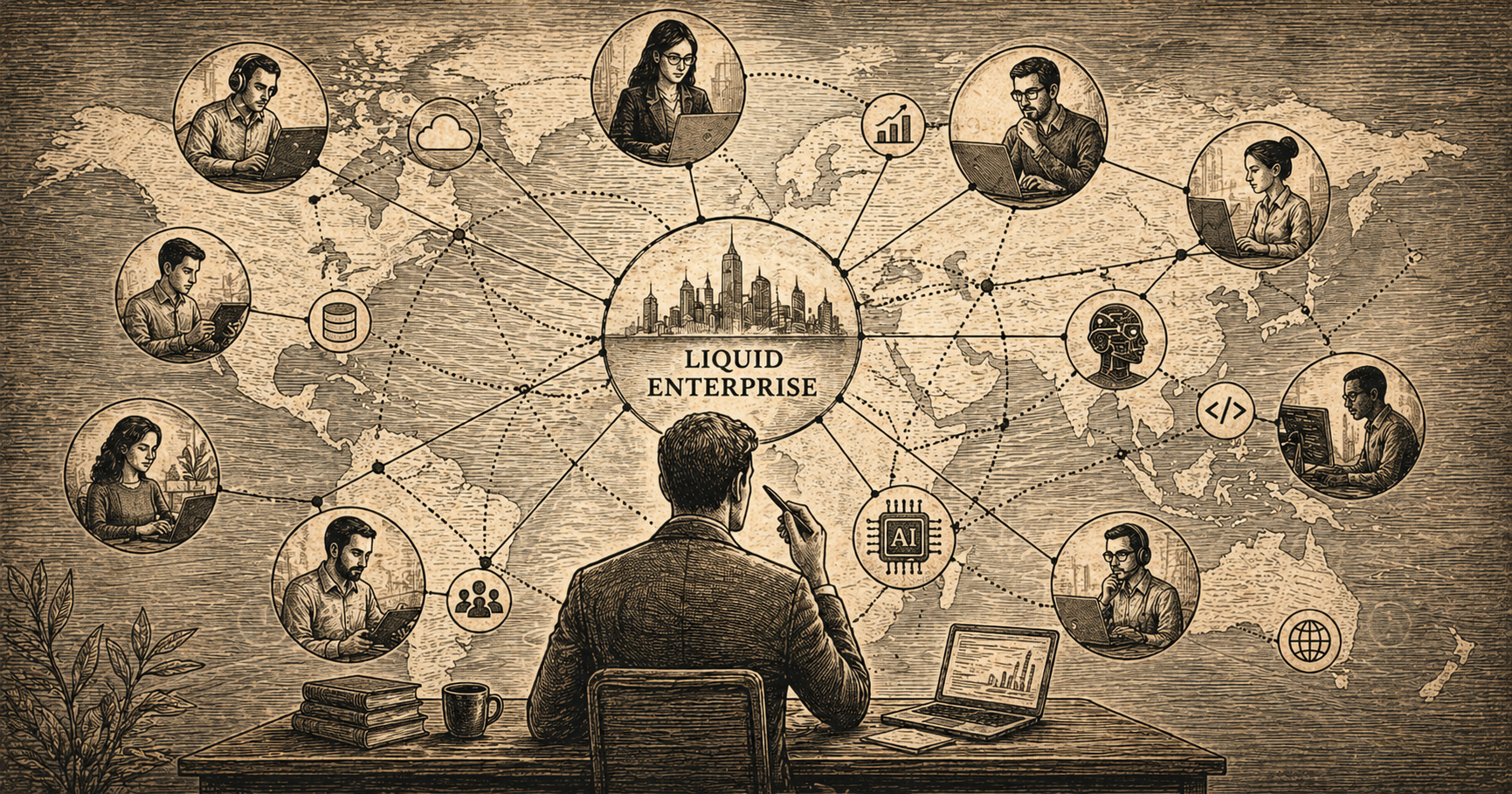
Fractional workforce management is emerging as a defining feature of modern organizations. The traditional corporate structure is evolving into something more fluid and distributed.
From the mid-eighteenth century to the present time, from the time of the industrial revolution, for much of modern business history, organizations were defined by clear boundaries in their work styles.
This is the liquid enterprise, a model where fractional workforce management becomes central to how organizations operate.
Employees worked within offices, their roles were fixed, and productivity was largely tied to how much time they spent within structured office environments. The so-called “corporate ladder” provided a predictable pathway for growth, and leadership was often about managing people within a defined system.
That structure is now changing.
Across geography and across industries, organizations are evolving into more fluid, networked systems; they are drawing on talent from multiple locations, employment models, and even non-human contributors such as artificial intelligence in recent times. As a result, what emerges is not a breakdown of the enterprise but a reconstitution, rather a reconfiguration of it.
This is the liquid enterprise, a model in which value is created not within rigid structures but through the orchestration of a distributed, flexible, and often temporary workforce.
For leaders, the challenge is no longer managing a workforce within boundaries.
It is coordinating capability across a system without them.
From Stable Employment to Distributed Capability
The age-old traditional employment model assumed stability. Human capability is the ultimate advantage.
Organizations hired full-time employees, invested in long-term roles, and built internal capabilities over time. While external vendors and consultants existed, they were mostly supplementary.
Today, that balance is shifting. Organizations are increasingly combining full-time employees, independent consultants, project-based specialists, and platform-based workers.
You may find this concept in the corporate sphere. Technology startups and digital-first companies often operate with relatively small core teams. They rely more on a global network of external specialists, which may include designers, developers, analysts, and advisors, and they may be engaged on demand.
This is also evident with even large enterprises. They are adopting similar approaches for specific functions, such as marketing, data analytics, and product development.
Therefore, we can safely say that work is no longer organized around fixed roles. It is organized around specific outcomes and capabilities.
The End of the Full-Time Monopoly
However, does that mean that full-time employment is disappearing? The answer is a clear ‘No’. They are no longer the dominant model through which all work is structured. As a result, job security feels weaker in a world of expanding opportunities.
Many professionals today prefer flexibility. They choose to engage in multiple roles or projects simultaneously. At the same time, organizations seek agility. They try to avoid long-term commitments when conditions remain uncertain.
In the corporate world, platform-based ecosystems, ranging from professional networks to freelance marketplaces, enable companies across the entire bandwidth to access specialized skills without long-term hiring commitments. This allows rapid scaling of capability without expanding permanent headcount.
Therefore, the shift is not from employment to unemployment. It is from full-time employment to part-time engagement.
We notice that organizations increasingly “assemble” teams for specific objectives rather than “own” them indefinitely for life.
Leading in a Human–Machine Hybrid Environment
We come back to the core thought. The liquid enterprise is not just defined by flexible human talent. It also includes intelligent systems.
Artificial intelligence is now integrated into workflows across industries. It helps perform tasks that were previously handled by employees. This creates a hybrid environment where human and machine contributions coexist.
In areas such as finance, supply chain management, and customer operations, AI systems process large volumes of data and generate insights, while human professionals interpret results and make decisions. The global supply chains are being rewritten.
Here we notice that technology enhances execution. However, the human capability defines direction.
As explored in discussions on the limitations of artificial intelligence, machines operate within patterns and rules. They do not fully account for ambiguity, context, or ethical trade-offs.
The New Leadership Role: Orchestration
In this environment, leadership itself is being redefined.
Leaders are no longer primarily supervisors of people performing predefined tasks. Instead, they act as coordinators of a system that includes very diverse human contributors, external partners, and intelligent tools.
Project leaders in global organizations often manage teams distributed across geographies, time zones, and contractual arrangements. Here the decision-making requires integrating inputs from multiple sources rather than following a single hierarchical structure.
So to say, leadership is shifting from control to orchestration.
Therefore, the effectiveness of a leader depends on their ability to align diverse capabilities toward a shared objective.
Building Culture Without Physical Proximity
One of the most significant challenges in a liquid organization is maintaining organizational culture. By definition, this was always imbibed through close contact interactions.
In traditional settings, culture was reinforced through shared physical spaces, daily interactions, and long-term relationships.
In distributed systems, these mechanisms are weaker.
Remote-first organizations and globally distributed teams often rely on structured communication, shared documentation, and clearly defined values to maintain alignment.
Some organizations invest in periodic in-person interactions, but the primary driver of culture remains clarity of purpose.
We can say culture is no longer sustained by proximity. It is sustained by shared understanding and consistent communication.
In a system where individuals have multiple options available to them, this engagement is not enforced; rather, it is chosen.
The Challenge of Coordination and Cognitive Load
While flexibility increases capability, it also introduces complexity.
Managing multiple contributors, both human and technological, requires continuous methodical coordination. The amount of information increases. Decision points multiply, and as a result, the risk of fragmentation grows.
Leaders often operate across multiple platforms, such as communication tools, project management systems, and data dashboards. Each generates inputs that require separate attention and response.
You may also notice here that the efficiency gains from flexibility can be offset by coordination costs. This makes clarity, prioritization, and structured workflows critical.
The Geopolitical Dimension of a Borderless Workforce
Since the geographical boundary no longer remains a boundary, distributed workforces operate across jurisdictions. This introduces exposure to regional regulatory differences available in labor laws, data protection requirements, and geopolitical shifts.
Organizations operating across borders must adapt to varying regulations related to remote work, data localization, and employment classification. This shift reflects a broader move toward fractional workforce management, where organizations assemble capabilities on demand.
Therefore, changes in policy can directly affect workforce structure. The liquid enterprise must be highly responsive but also highly sensitive to external conditions.
As discussed in broader policy and economic analyses, governments are increasingly influencing markets and labor systems. Therefore, the regulatory awareness becomes a key leadership capability.
From Role-Based to Outcome-Based Thinking
A defining feature of the liquid enterprise is the shift in how work is evaluated.
We also notice that traditional metrics, such as how many hours worked, presence in the workplace, and working tenure, are becoming less relevant.
Instead, the present emphasis is on deliverables, impact, and quality of output.
In project-based activities, success is often measured by the number of milestones achieved rather than the amount of time spent. This allows for greater flexibility in the way work is done.
We notice it increasingly that in a distributed system, results become the primary measure of value.
What This Means for Young Leaders
For emerging leaders, the implications are significant. We may summarize that success in a liquid enterprise requires a few things. These may include the ability to work across boundaries, getting comfort with ambiguity, skill in coordinating diverse contributors, and, of course, awareness of global dynamics.
Leadership is no longer about managing people within a structure. It is more about creating alignment across a system. The future of organizations will depend on how effectively leaders implement fractional workforce management.
A Changing Model of Organization
We also notice that there lies a straightforward difference between traditional and these emerging models.
| Earlier Model | Emerging Model |
| Fixed workforce | Flexible, distributed workforce |
| Role-based structure | Outcome-based structure |
| Centralized teams | Networked contributors |
| Physical proximity | Digital coordination |
| Stability-focused | Adaptability-focused |
Key Takeaways
- Organizational boundaries are becoming more fluid.
- Work is shifting from fixed roles to flexible, outcome-based engagements.
- Leadership is evolving from supervision to orchestration.
- Culture must be built through clarity rather than proximity.
- Distributed systems increase both capability and complexity.
- Global and regulatory awareness is becoming essential.
Closing Thought
The structure of organizations is not disappearing. It is becoming more fluid. In this new environment, The most effective leaders will not be those who control systems.
but those who can coordinate their team without rigid boundaries.