

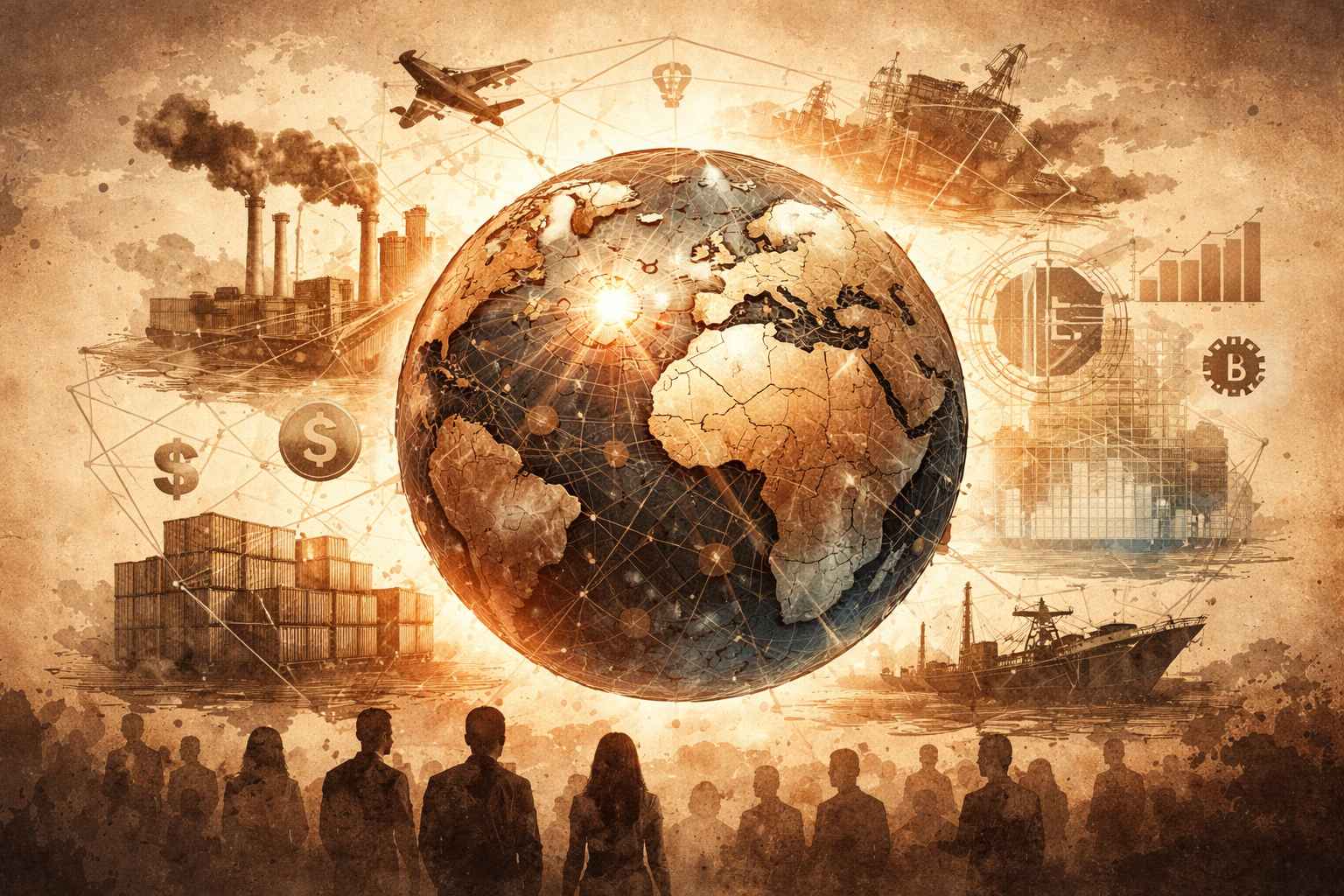
Across the world today, uncertainty is no longer driven by a single crisis. Instead, it stems from the accumulation of economic, political, technological, and security pressures unfolding simultaneously. This overlap makes long-term, sustainable outcomes increasingly difficult to predict.
What distinguishes the present moment is not the presence of crises themselves, but the fact that multiple sources of instability now operate at the same time. As a result, uncertainty has moved beyond being episodic—it has become structural.
What Is Driving Today’s Global Uncertainty?
Periods of global tension are not new. History has repeatedly witnessed economic downturns, political conflicts, and technological disruptions. What makes the current phase feel different is the number of unresolved challenges unfolding in parallel.
Economic slowdowns, political polarization, rapid technological change, and security concerns are no longer sequential events. They overlap and reinforce one another. Governments are under pressure to address domestic expectations while simultaneously managing international responsibilities. Institutions originally designed to ensure stability are now being tested by fast-moving and interconnected risks.
Even when one crisis fades from headlines and gives way to another, the underlying drivers of instability remain largely unresolved.
Shifting Power Dynamics Without a Clear Center
For much of the past few decades, global affairs were shaped by relatively stable power arrangements. That stability is now under strain.
The United States remains a central global actor, but its international role is increasingly shaped by internal priorities and strategic recalibration. China continues to expand its influence while managing domestic economic and demographic constraints. Europe is balancing security concerns, energy transitions, and internal political fragmentation.
What is emerging is not a transition toward a new dominant power, but a more fragmented and competitive global landscape. Influence is increasingly distributed, contested, and situational rather than centralized.
Economic Pressures That Cross Borders
Economic developments are no longer confined within national boundaries. Decisions taken in one part of the world increasingly shape outcomes elsewhere, sometimes across continents.
Inflation trends, interest rate changes, and trade restrictions now ripple rapidly through global supply chains. Economic tools such as tariffs, sanctions, and subsidies are used more openly as instruments of state strategy. As a result, economic policy and foreign policy interact in real time.
This interconnectedness reduces predictability—not only for governments, but also for businesses and individuals—making long-term planning more complex and cautious.
Technology as a Strategic Fault Line
Technology has become one of the most sensitive areas in world affairs—not merely because of innovation, but because of dependence and control.
Competition over semiconductors, artificial intelligence, data infrastructure, and digital governance is intensifying. Governments are increasingly involved in regulating, protecting, and sometimes restricting access to critical technologies.
What matters today is not only who innovates fastest, but also who controls supply chains, operating standards, and data ecosystems. Technology, once primarily a connector and enabler, has become a strategic fault line that reshapes global relationships.
Security Challenges Without Clear Endpoints
Security concerns today are less about clearly defined wars and more about persistent instability.
Regional conflicts continue without clear short- or medium-term resolutions. Cyber threats and information warfare complicate traditional responses. Defence spending is rising across regions, even as governments face growing fiscal pressures.
What makes this environment particularly challenging is the absence of clear endpoints. Many risks are managed rather than resolved, reinforcing a prolonged sense of uncertainty.
Why This Matters Beyond Diplomacy
World affairs increasingly shape decisions far beyond diplomatic circles.
Businesses reassess investment plans based on geopolitical risk. Professionals encounter job markets influenced by global supply shifts. Governments must balance domestic expectations with international constraints and competing priorities.
In this context, uncertainty itself becomes a powerful input into global economic outcomes. Decisions are often delayed, risk tolerance declines, and long-term planning becomes more cautious—even in the absence of immediate crises. In such environments, even well-designed policies often struggle at the delivery stage due to institutional execution constraints.
What to Watch for in the Near Future
Rather than reacting to daily headlines, broader signals offer better insight into where global affairs may be heading in the short to medium term.
Key questions include:
- How do major economies coordinate—or fail to coordinate—during periods of stress?
- How is the balance between economic openness and security concerns managed?
- What will be the pace and scope of technology regulation?
- Will public trust in institutions hold during extended periods of uncertainty?
The answers to these questions are likely to shape global outcomes more than isolated events.
Key Takeaways
Global uncertainty today is cumulative rather than driven by single events.
Power structures are becoming more fragmented, with influence increasingly distributed rather than centralized.
Economic policy, technological innovation, and security concerns are deeply interconnected, making long-term predictability more difficult.
In this environment, context and interpretation matter more than headline tracking or knee-jerk reactions.
