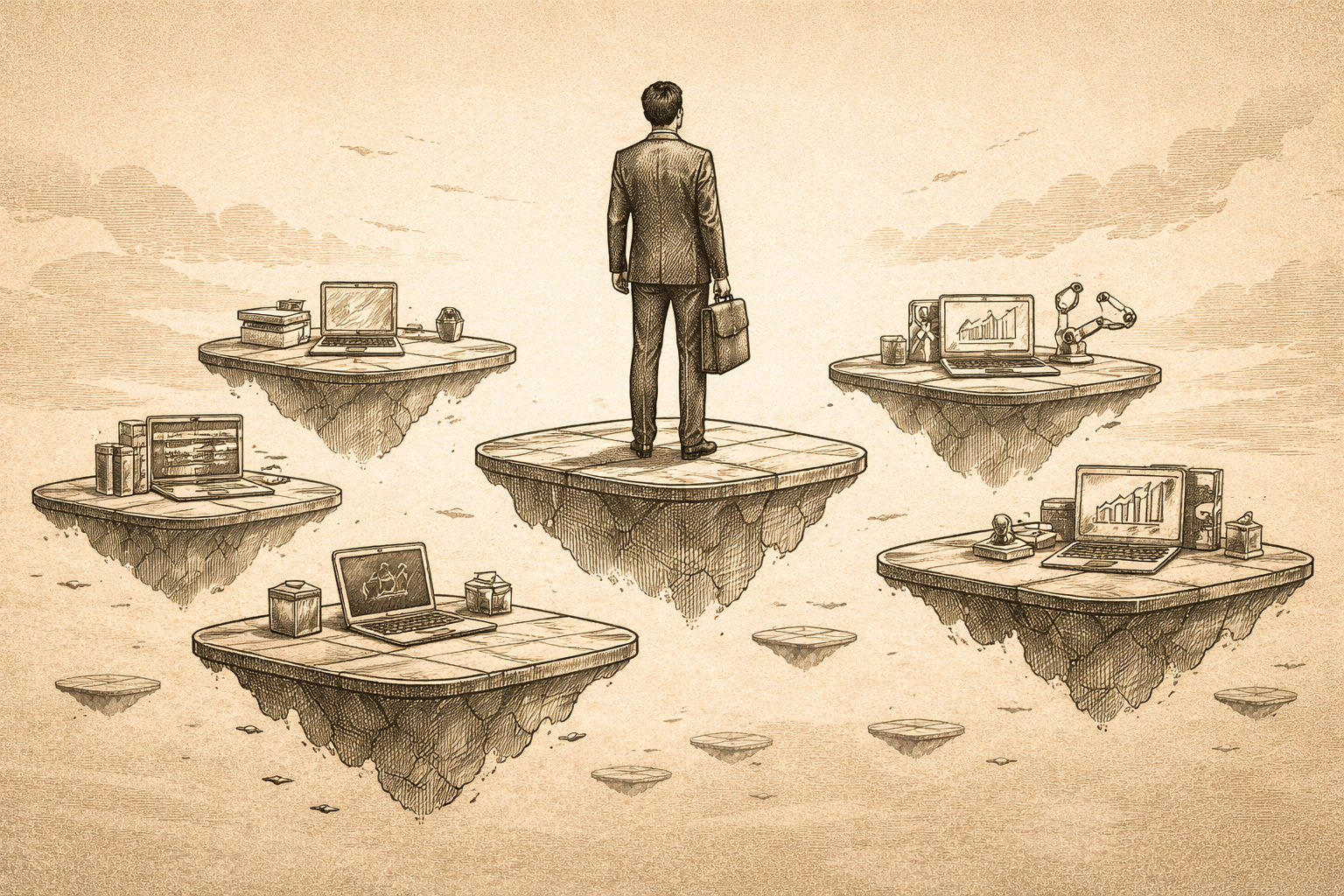
The all-powerful labor market presents a striking contradiction in today’s global economy.
As is evident, on one hand, opportunities across the globe are expanding. New roles in artificial intelligence, digital services, and global platforms are growing rapidly. However, on the other hand, job security feels increasingly fragile.
It seems that there lies a new work paradox.
Conclusive data shows that there have never been more ways to earn an income, yet there has never been such a less confidence in the longevity of a single career path.
The End of the Traditional Career Model
History shows that for much of the past, people’s careers followed a predictable trajectory. Employees joined organizations, progressed through defined roles, and built long-term stability through their entire tenure.
Today, that model is weakening.
Today’s organizations operate in much faster and more volatile environments. Their business cycles are shorter, and there is global competitive pressures. The companies are also exposed to fast changing terms in corporate laws. As a result, companies are less willing to commit to long-term employment structures.
Large technology firms such as Oracle, Google and Amazon, once known for their solid stability, have conducted multiple rounds of layoffs in recent years. This happened even while continuing to hire in much needed and specific high-priority areas like AI and cloud computing.
So to say, careers are becoming less linear and more project-driven. They depend more on evolving capabilities.
We may conclude that the structure of employment is shifting from permanence to fluidity.
The Stability vs. Quality Gap
If we analyze the employment data, we may see that the headline numbers often suggest stability. However, beneath these figures lies a different reality.
The global unemployment rate remains relatively stable, but the quality of employment is diverging. A very significant number of workers are engaged in informal, contract-based, leased or gig roles without long-term benefits.
Platforms such as Uber, Swiggy, Zomato and DoorDash have created millions of earning opportunities. Yet many workers in these ecosystems lack basic health insurance and retirement benefits. They can not even prdict their income next month.
Dp to say, security has shifted from being provided by the employer to being managed by the individual themselves.
For sure, their job role creates flexibility. However, this comes at the cost of vulnerability.
Why Companies Are Choosing Flexibility
Also organizations are not reducing stability arbitrarily. they are actually responding to economic and other market uncertainty.
As we have discussed in how companies are becoming more risk-averse in an uncertain economy, businesses are increasingly cautious in committing fixed costs, including permanent employment.
Companies like Meta and Microsoft continue to invest aggressively in AI while they are simultaneously reducing workforce size in non-core areas.
This reflects a clear pattern. They hire selectively and reduce their fixed commitments. This improves their capacity to maintain operational flexibility.
Flexibility improves resilience for organizations—but transfers risk to employees.
The Agentic AI Shift: Displacement vs. Augmentation
Artificial intelligence is accelerating the transformation of work.
The latest wave is often described as “Agentic AI”. Itis capable of executing multi-step tasks, that reduces the need for certain entry-level roles.
In reality, we notice that AI tools are increasingly handling content drafting that essentially handles marketing roles. They also deal with data analysis tasks and customer support interactions.
At the same time, AI is creating demand in data center infrastructure, AI model development, and less-energy compute systems.
We see that the real disruption is not just job loss; it is the erosion of entry-level pathways. What artificial intelligence still cannot do and why it matters will remain a matter of discussion in times to come.
We also notice that the traditional “apprenticeship layer” of organizations is shrinking. This makes career progression less visible and more uncertain.
The Rise of the Portfolio Career
In response to declining stability, individuals are changing how they approach work.
Instead of relying on a single employer, many professionals are building portfolio careers that deal with multiple income streams across roles and platforms.
What we find is that professionals today may simultaneously hold a full-time job and consult independently. They can also create digital products or content for social media platforms.
A recent trend shows a large proportion of professionals actively exploring new opportunities even while employed.
This shows that we have moved from having desire to master one “large ship” to having multiple “small boats.”
This shift increases flexibility. This also creates continuous pressure to perform and adapt.
The Rise of Replaceable Work
Another structural shift is the growing standardization of work.
Let’s take this example. When tasks are clearly defined and digitally executable, in all probability, they are globally transferable.
This way, they become easier to replace, either by simple automation or by a global workforce.
A recent trend shows that outsourcing firms and AI-driven platforms are now competing directly with traditional white-collar roles. The roles such as data entry, basic financial analysis, and routine content creation are increasingly becoming AI-driven.
So a new picture is coming up. Stability is no longer tied to a job title. It is tied to how difficult you are to replace.
The Geopolitical and Regulatory Squeeze
The labor market is also being shaped by policy and global dynamics.
As governments redefine trade, regulation, and labor frameworks, work is becoming more fragmented across borders.
New regulations around gig work in Europe, US and India are attempting to classify platform workers, but many still operate outside formal protections.
What we find is that at the same time, companies face restrictions on cross-border hiring, data movement across nations, and remote work compliance as enforced in different countries.
Another interesting base shift is noticed here. The structure of work has become global, but the rules governing it remained largely local.
This mismatch increases uncertainty. This growing uncertainty is also driving a deeper shift toward reskilling, where long-term stability depends increasingly on human capability rather than fixed roles.
The Psychological Impact: The Quiet Pressure
Beyond economics, the most significant impact is psychological.
Even when opportunities exist, professionals experience constant pressure to upskill. They fear of becoming obsolete. Therefore, they face difficulty planning their long-term goals.
High-performing professionals in sectors like consulting, tech, and finance report increasing burnout. It is not due to lack of work, but due to continuous uncertainty and performance pressure.
This is not just a labor market shift. It is a shift in how individuals experience work itself.
What This Means for Young Leaders
For emerging leaders, the implications are profound. Leaders struggle to decide, even with more information.
The traditional model of building a career within a stable structure is no longer sufficient.
Instead, leaders must focus on building adaptability and cross-domain understanding. They must try to learn decision-making capability and imbibe in them a continuous learning system.
So we notice a paradigm shift. You no longer build a career around a role. You build the ability to evolve across diversified roles.
From Job Security to Capability Security
Therefore, it is evident here that the concept of security is being redefined.
In the past
- security = employer stability
Today:
- security = personal capability + optionality
Professionals with multiple skills and cross-functional exposure usually have strong networks. These versatile professional will be significantly more resilient than those dependent on a single role.
Stability is no longer guaranteed, it is constructed.
The New Model of Work (Comparison)
| Feature | Earlier Model (Stability) | Current Model (Agility) |
| Source of Security | Employer | Individual capability |
| Career Path | Linear | Non-linear |
| Income | Single source | Multiple streams |
| Skills | Specialized | Adaptive & evolving |
| Risk | Organization | Individual |
Key Takeaways
- Opportunities are expanding, but stability is becoming more individual-driven.
- Organizations are prioritizing flexibility over long-term employment commitments.
- AI is reshaping roles and reducing traditional entry-level pathways.
- Portfolio careers are increasing, but so is continuous pressure.
- Work is becoming more replaceable unless differentiated.
- Psychological resilience is becoming as important as professional skill.