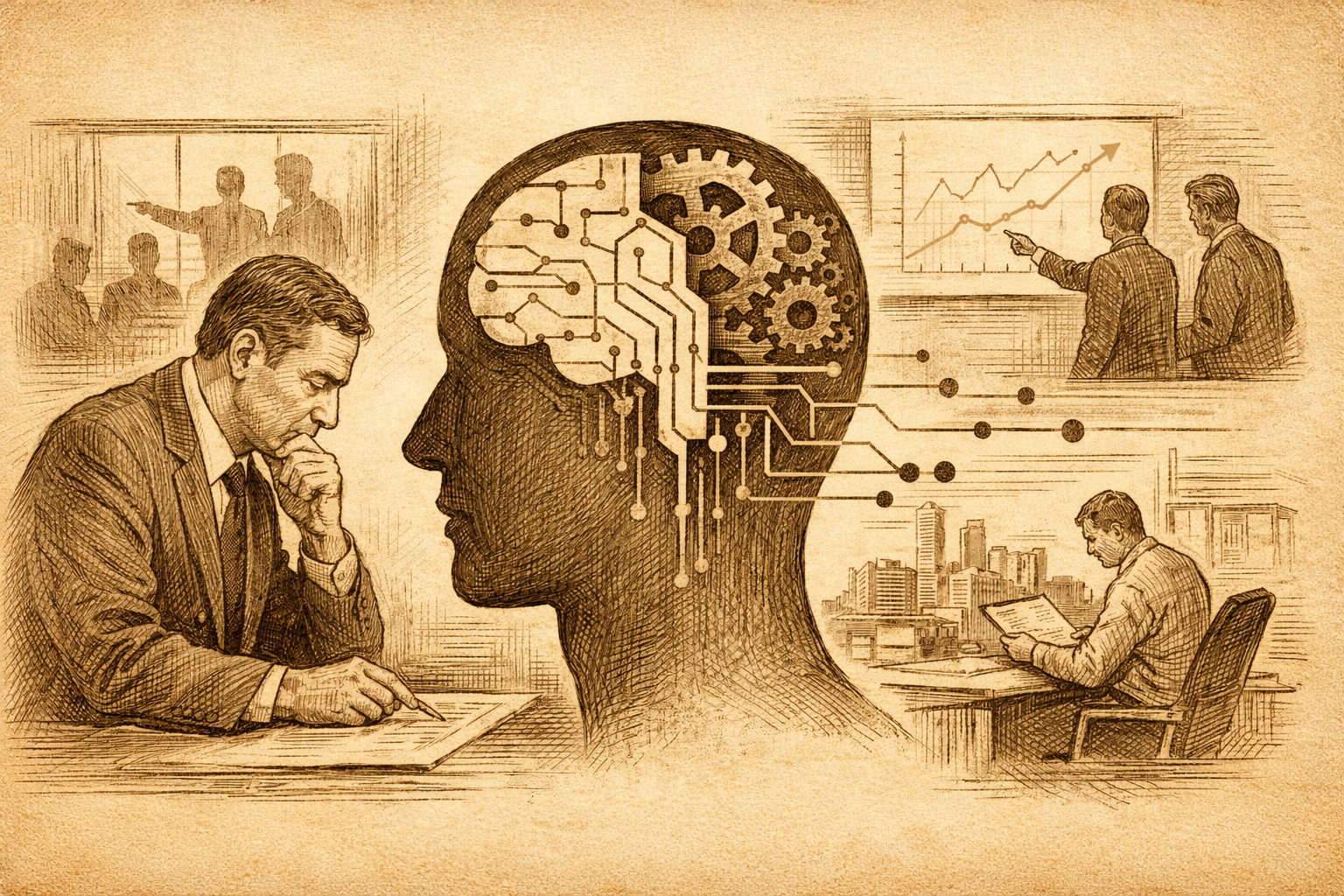
Across industries, there is a concern about job losses, and it is rising. Companies from global technology firms to all-powerful outsourcing giants are restructuring roles while accelerating investments in artificial intelligence. News of workforce reductions at organizations such as Amazon, Google, Meta, and large IT employers like TCS and Infosys has only intensified large-scale public anxiety about whether AI is replacing work faster than global economies can adapt.
Job disruption is not new to society. What feels different today is that AI is not only automating physical tasks; it is automating the human cognitive work as well. We noticed many times that the history repeats itself. To understand what may come next, it shall help us view this present moment through a longer historical lens.
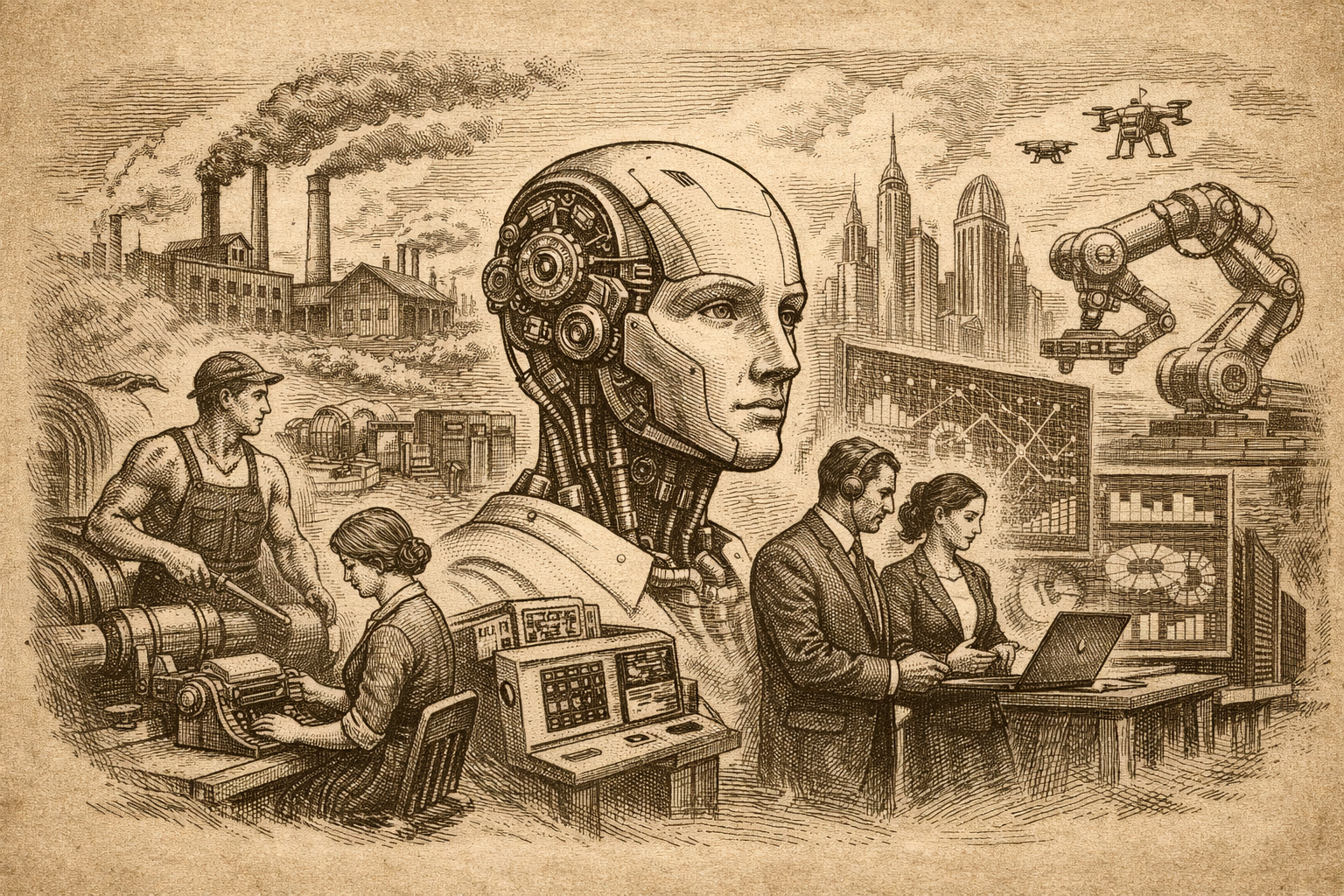
A Pattern as Old as Industrial Change
History shows that major technological shifts have always reshaped labor markets. Each change wave initially faced resistance, uncertainty, and large-scale displacement.
But over time, we are convinced that it also generated new sectors, new occupations, and new forms of value creation across the horizon. These shifts are also contributing to a broader work paradox, where job opportunities are increasing even as long-term security becomes less certain.
By that notion, the history of industrial revolutions is, in many ways, the history of work reorganization.
Industrialization and the Rise of Labor Movements
The first large-scale transformation came with industrialization. Mechanized production shifted economies away from agriculture and small workshops toward factories.
This transformation brought sure productivity gains and mass factory employment in every sector. However, this also accelerated urban migration, and eventual rise of organized labor forces and consequent trade unions and their movements.
The earliest trade union movements emerged partly as a response to mechanization and the new power structures of industrial work. The disruption was real—but so was the expansion of opportunity
The Computer Age: Resistance Before Adoption
The next major disruption arrived with computerisation. In many industries, early adoption faced resistance from multiple areas. Banking sector is a classic example to study this challenge.
In banks and in other spaces, when computerized systems were introduced, fears of large-scale clerical job losses triggered opposition, that ended in nation-wide strikes in some regions. Yet today, no modern bank can function without necessary and sufficient digital infrastructure, that is future safe.
For sure, these works did not disappear, it helped evolve the entire ecosystem to come out from the challenge of manual recordkeeping to modern IT systems, compliance oversight, analytics, cybersecurity, and all-powerful digital services.
Therefore, we see that computerization has eliminated certain repetitive and mundane tasks. And they expanded the scale, efficiency, and sophistication of the entire industry they are employed in
The Internet Era: Entire Industries Reorganized
As the internet and its peripheral technologies arrived, it transformed many facets of communication, publishing, advertising, media, and commerce. As a result of this transformation, traditional and common roles declined. But a new set of roles emerged. A few new roles include digital marketing, social media strategy, online content creation, influencer-driven brand ecosystems, and e-commerce operations.
Earlier, many roles required a large team to deliver alongside them to achieve the goals. But now many individuals with the required new set of skills and creativity are able to do those alone with a suitable platform and audience reach. Many legacy roles have disappeared, but millions of new opportunities emerged in adjacent systems.
So we can safely conclude that these disruptions did not end work. It only redistributed it among many other ancillary works.
Automation at the Shop-Floor Level
Historically, waves of automation primarily replaced repetitive physical work at the industrial shop floor.
In manufacturing sectors such as ceramic sanitary ware, robotic glazing systems replaced manual processes. A plant that once required dozens of workers for repetitive tasks could operate with significantly fewer personnel supported by automated systems. Similarly, in paint shops in car manufacturing plants, automation improved product quality, speed of production and overall safety of the workforce.
These adjustments were difficult in the beginning. So it is understandable that machines replaced human labor at the task level.
With AI comes a different level of intervention. It introduces a more complex transition.
AI Automation Is Different: It Touches Cognitive Work
As we are experiencing, artificial intelligence increasingly applies not only to physical execution but also to many other facets of work. This includes,
- Document review and processing
- Software Coding assistance
- Customer care and support service automation
- Design workflows
- Data analysis and forecasting
- Managerial coordination and decision support
This is the very reason, why the current transformation feels more profound. In earlier transformations, we found how human manual work were automated. But this time, AI appears to automate parts of the human mind, not only the human hand.
Yet history suggests that even cognitive disruption follows a specific structural patterns.
The Job Transformation Pattern
Across technological revolutions, a recurring sequence appears:
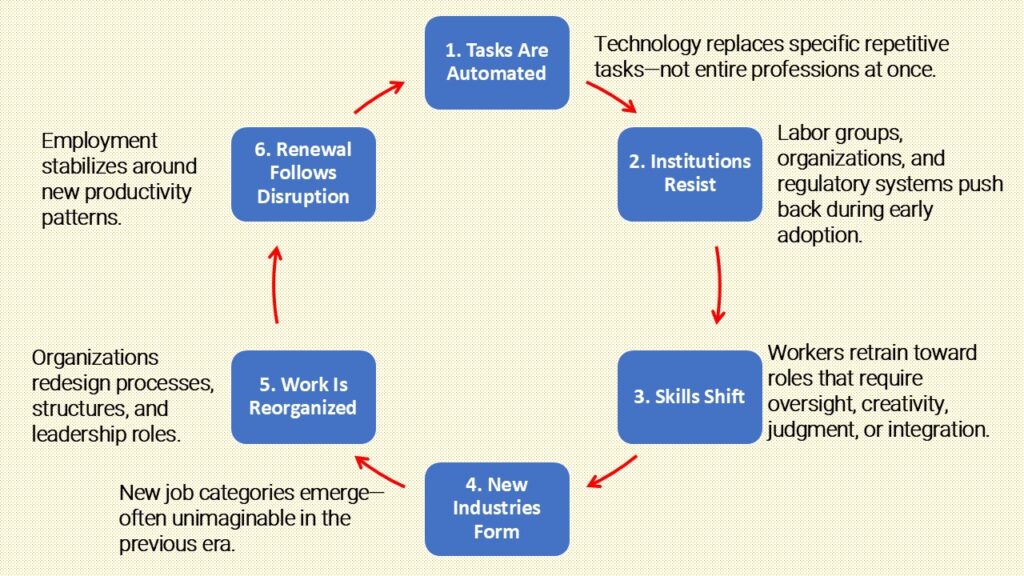
Historically, it is observed that this cycle has repeated during transformations, across industrialization, computerization, the internet revolution, and robotic automation. And ofcourse, AI is the latest—and most cognitively disruptive—phase of the same evolutionary process.
Technology Shifts and Job Outcomes: A Historical Comparison
We provide here a comparison that highlights a consistent historical pattern across major technological shifts.
| Technological Wave | Initial Disruption | Long-Term Outcome | New Roles Created |
| Industrialization | Factory displacement, labor unrest | Expansion of industrial employment | Industrial systems management |
| Computers | Fear of clerical job loss | Digitized service economies | Software, IT services, analytics |
| Internet | Decline of print media roles | Platform-based digital economy | Social media, e-commerce, digital marketing |
| Robotics | Reduction of repetitive manual tasks | Higher productivity manufacturing | Automation engineering, robotics maintenance |
| Artificial Intelligence | Cognitive task disruption | Still unfolding | AI governance, human-AI coordination, applied innovation |
Each wave initially triggered fears of job loss as familiar roles were disrupted. Over time, however, work did not disappear; it reorganized around new systems, tools, and value creation models. Industrialization expanded factory-based employment, computers created digital service economies, and the internet enabled entirely new platform-driven careers.
In each case, productivity gains were accompanied by new roles that required different skills. Artificial intelligence follows the same trajectory, although its impact reaches deeper into cognitive and managerial tasks. The table illustrates that while disruption is immediate, regeneration tends to unfold gradually as economies adapt and new forms of work emerge.
Where the Hidden Opportunity Lies
As is witnessed all through, AI will likely reduce demand for routine cognitive work. But it is simultaneously expanding demand for many other facets of work. These shall include 1] AI governance and ethical oversight, 2] Human-centered design, 3] Systems integration, 4] Industry-specific AI application, 5] Strategic problem framing, and 6] Cross-functional coordination
Therefore, most importantly, the opportunity lies not in resisting automation but in understanding where value is migrating.
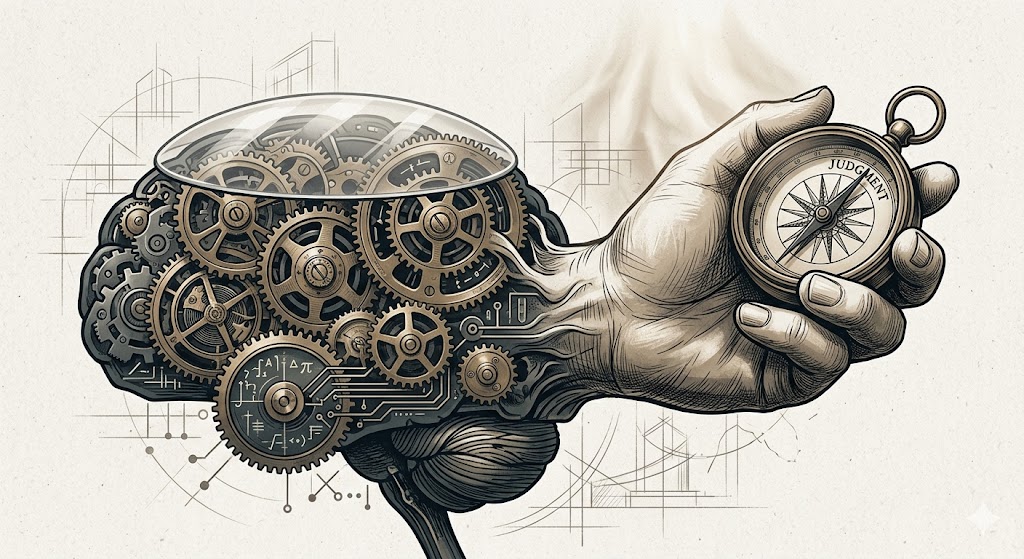
This essentially means that work does not vanish; it relocates. From repetitive execution to thoughtful interpretation, skillful integration, and humane judgment.
What This Means for Young Leaders
For young leaders, AI is not merely a technological shift. It is a structural and institutional shift.
The defining question is not simply, Will jobs disappear? It is, Which capabilities will remain indispensable?
Experts remind us that there will be some skills that are most likely to endure across revolutions. Following is a list of some of those kinds of skills that will be passing the test of time. These may include:
- Domain expertise combined with AI literacy
- Judgment and problem framing
- Ethical reasoning and governance awareness
- Human trust-building and collaboration
- Adaptability to continuous learning
The leadership paradigm is changing very fast across the industry and academic landscape. In the AI era, this will depend much less on performing mundane tasks and considerably more on designing optimized systems, aligning people to a common goal, and interpreting technology responsibly for a greater cause.
As technology reshapes work and organizations, leaders increasingly face difficult judgment calls—even when more information is available than ever before.
Therefore, it is safe to assume that AI does not eliminate the need for leadership. It increases the need for thoughtful leadership and its implementation.
Key Takeaways
There are a few takeaways that we may consider for the AI revolutions. Moving forward, these aspects helps us prepare ourselves for the onward journey.
- Job displacement has accompanied every major technological revolution.
- AI differs because it disrupts cognitive and managerial tasks.
- Historical patterns suggest that new industries and connected roles will emerge alongside AI disruption.
- The future of work depends more on skill transition, not job extinction.
- Young leaders who combine domain knowledge with AI fluency will be positioned to lead change.
In summary, work does not disappear. It migrates; from old tasks to new value.
The future belongs to those who recognize where the value is moving and move with it.