

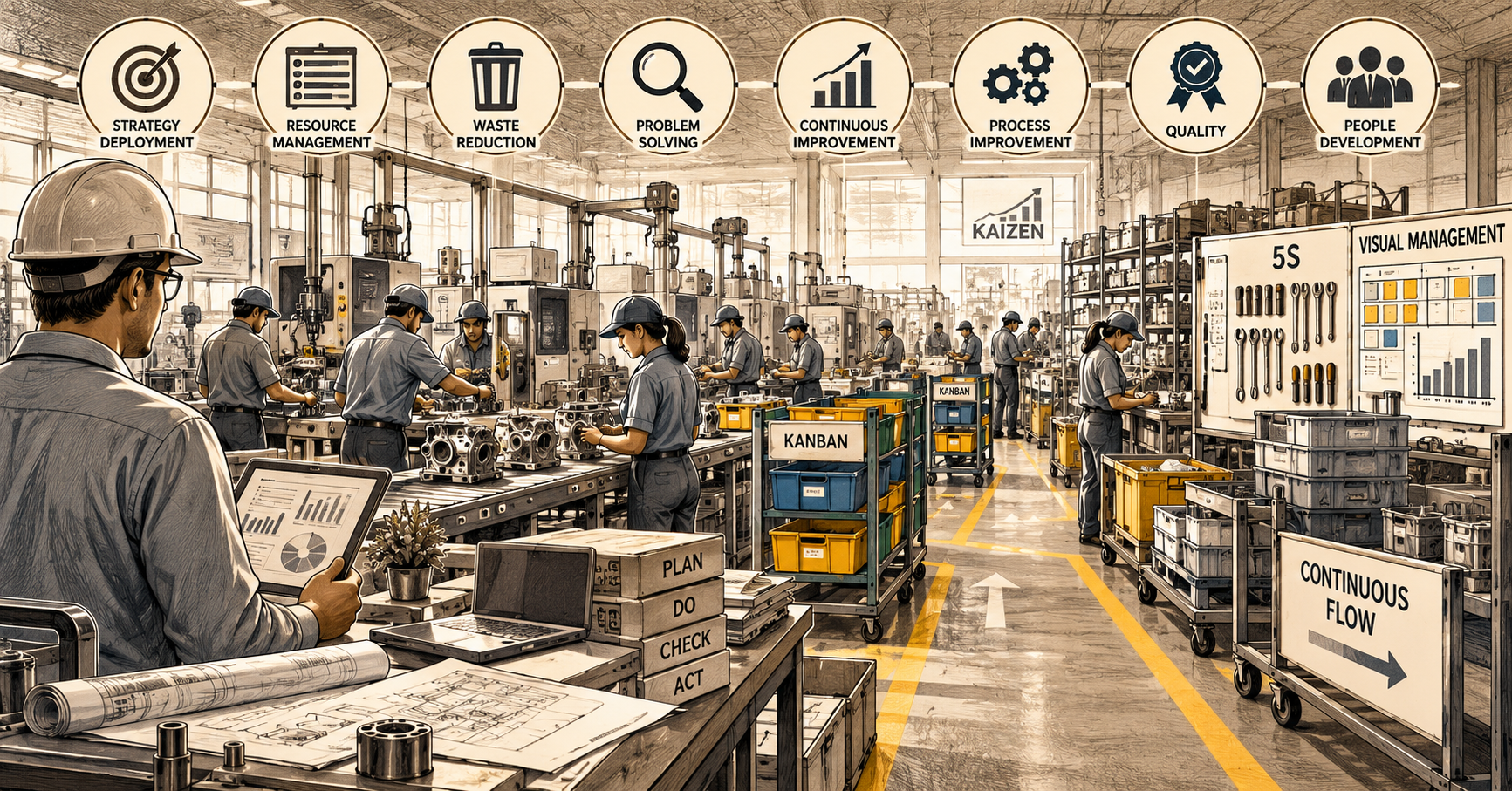
Lean manufacturing is more than a collection of techniques used on a factory floor. It is a management philosophy built around creating value for the customer while systematically reducing waste, improving flow, solving problems and developing people.
Over the decades, organizations across manufacturing and service industries have adopted a wide range of Lean tools to translate these principles into everyday practice.
But there is an important point to understand:
Lean tools do not work in isolation.
Kanban, Kaizen, 5S, Value Stream Mapping, Poka-Yoke, SMED, Jidoka, Heijunka, Standardized Work and other tools are parts of a broader system. Each addresses a particular type of problem, and many work most effectively when combined with others.
This guide provides an overview of 21 important Lean Manufacturing tools and practices, explains how they relate to one another, and shows how organizations can use them to build more capable, responsive, and continuously improving processes.
1. What Is Lean Manufacturing?
Lean Manufacturing is an approach to managing and improving processes by focusing on customer value, flow, waste reduction, problem solving and continuous improvement.
Although Lean has roots in the development of the Toyota Production System, its principles have expanded far beyond automotive manufacturing.
At its heart, Lean asks several fundamental questions:
- What does the customer actually value?
- Which activities create that value?
- Where is waste occurring?
- Why does the process behave the way it does?
- How can problems be prevented rather than repeatedly corrected?
- How can work flow more smoothly?
- How can people participate in improving the process?
- How can improvements become part of the normal way of working?
Lean, therefore, combines process thinking, operational discipline, problem solving and human development.
2. Why Do Lean Manufacturing Tools Matter?
Lean principles can be powerful, but organizations need practical mechanisms to translate principles into action.
This is where Lean tools become important.
Consider a manufacturing process with:
- excessive inventory,
- long changeover times,
- recurring defects,
- uneven production,
- poor workplace organization,
- unclear performance information,
- equipment breakdowns,
- excessive movement,
- waiting,
- rework and
- poor coordination between processes.
There is no single tool that can solve all these problems.
Different problems require different approaches.
For example:
| Operational Challenge | Potential Lean Tool |
| Poor workplace organization | 5S |
| Excess inventory and uncontrolled production | Kanban |
| Long changeover time | SMED |
| Defects caused by human or process errors | Poka-Yoke |
| Equipment or process abnormalities | Andon |
| Uneven production demand | Heijunka |
| Excessive waiting and interruptions | Flow / JIT |
| Root causes of recurring problems | Root Cause Analysis |
| Workplace observation | Gemba |
| Small, continuous improvements | Kaizen |
| Strategy-to-action alignment | Hoshin Kanri |
| Making process conditions visible | Visual Management |
| Mapping material and information flow | Value Stream Mapping |
The tool is therefore not the objective.
Improvement is the objective.
The tool is simply one of the mechanisms through which improvement can be achieved.
3. Lean Tools and the Five Principles of Lean
A useful way to understand Lean tools is to connect them with the five commonly recognized Lean principles:
1. Identify Value
Understand what the customer needs and is willing to value.
2. Map the Value Stream
Understand how materials, information and activities move through the process.
3. Create Flow
Remove interruptions and unnecessary delays so that work can move smoothly.
4. Establish Pull
Produce or replenish based on actual demand rather than simply pushing work into the system.
5. Pursue Perfection
Continuously improve the process and develop better ways of working.
The Lean tools support these principles in different ways.
For example:
Value Stream Mapping helps organizations understand the current value stream.
5S and Visual Management create visibility and stability at the workplace.
Standardized Work establishes a reliable baseline.
Kanban supports pull.
JIT and Continuous Flow support flow.
Kaizen and PDCA support continuous improvement.
Poka-Yoke and Jidoka help build quality into the process.
Hoshin Kanri connects improvement activity with organizational strategy.
Thus, Lean tools should be viewed as an interconnected system rather than a toolbox from which isolated techniques are randomly selected.
4. The 21 Lean Manufacturing Tools in This Series
This series explores 21 important Lean Manufacturing tools, concepts and practices.
1. Hoshin Kanri
Hoshin Kanri is a strategic planning and deployment approach that helps organizations translate strategic objectives into coordinated actions across different levels of the organization.
It helps answer:
Where are we going, what must change, and how will different levels of the organization contribute?
[Link to detailed Hoshin Kanri article]
2. Kanban
Kanban is a visual signaling approach used to regulate the movement or replenishment of work based on demand.
It is closely associated with pull systems and can help control work-in-process and synchronize activities.
[Link to detailed Kanban article]
3. Just-in-Time
Just-in-Time (JIT) focuses on producing and delivering what is needed, when it is needed, and in the quantity needed.
Its effectiveness depends on process stability, reliable flow, quality, supplier coordination and appropriate production control.
[Link to detailed JIT article]
4. Muda
Muda refers to activities that consume resources without creating value from the customer’s perspective.
The commonly discussed categories include:
- Transportation
- Inventory
- Motion
- Waiting
- Overproduction
- Overprocessing
- Defects
Many organizations also consider underutilization of people’s capabilities as an important form of waste.
[Link to detailed Muda article]
5. Gemba
Gemba refers to the actual place where work is performed.
The principle behind going to Gemba is simple:
Go and see the actual process rather than relying entirely on reports or assumptions.
Gemba encourages leaders and problem solvers to understand conditions firsthand.
[Link to detailed Gemba article]
6. Poka-Yoke
Poka-Yoke refers to mistake-proofing methods designed to prevent errors or detect them as early as possible.
Rather than relying entirely on inspection after a defect has occurred, Poka-Yoke attempts to make errors difficult or impossible to make.
[Link to detailed Poka-Yoke article]
7. Root Cause Analysis
Root Cause Analysis (RCA) is a structured approach for understanding why a problem occurred.
Techniques such as:
- 5 Whys
- Cause-and-effect diagrams
- Fault tree analysis
- Pareto analysis
- Data analysis
can support systematic problem solving.
The fundamental idea is to avoid merely treating symptoms, and reach to the actual cause that creates the problem.
[Link to detailed Root Cause Analysis article]
8. Lean Six Sigma Project Deliverables
Lean and Six Sigma projects require more than identifying an improvement opportunity.
A structured improvement project typically involves clearly defined:
- Problem
- Goal
- Scope
- Baseline
- Analysis
- Improvement actions
- Control mechanisms
- Results
Understanding project deliverables helps ensure that improvement activity produces measurable and sustainable outcomes.
[Link to detailed article]
9. The Problem-Solving Strategy: Y = f(X)
The expression:
Y = f(X)
provides a useful way of thinking about process performance.
Here:
Y represents the output or result, while X represents the factors that influence that output.
Instead of repeatedly reacting to poor Y, Lean Six Sigma thinking encourages us to understand and control the important Xs.
This provides a bridge between process thinking, data and structured problem solving.
[Link to detailed Y = f(X) article]
10. Andon
Andon is a visual or audible signaling mechanism used to communicate abnormal conditions or problems.
Its purpose is not simply to display information.
An effective Andon system allows abnormalities to become visible quickly so that appropriate action can be taken.
[Link to detailed Andon article]
11. Kaizen
Kaizen is commonly associated with continuous, incremental improvement.
Kaizen encourages organizations to look for opportunities to improve processes regularly rather than waiting for major transformation projects.
Its deeper significance lies in creating a culture where improvement becomes part of everyday work.
[Link to detailed Kaizen article]
12. PDCA
The Plan–Do–Check–Act (PDCA) cycle provides a structured approach for testing, evaluating and standardizing improvements.
It encourages organizations to:
Plan → Do → Check → Act
rather than implementing changes without learning from their results.
PDCA can be used at many levels—from solving a shop-floor problem to managing a larger improvement initiative.
[Link to detailed PDCA article]
13. Voice of the Customer
Voice of the Customer (VOC) refers to systematically understanding customer needs, expectations and requirements.
Lean improvement ultimately has to connect back to value.
Therefore, understanding the customer is essential before deciding what should be improved.
[Link to detailed VOC article]
14. SMED
Single-Minute Exchange of Die (SMED) is an approach for reducing equipment setup and changeover time.
The central idea is to systematically analyze changeover activities and reduce the time required to switch from producing one product or configuration to another.
Shorter changeovers can enable greater flexibility and support smaller production batches.
[Link to detailed SMED article]
15. Jidoka
Jidoka is often described as providing machines or processes with the ability to detect abnormal conditions and stop or trigger intervention.
Its broader philosophy is closely connected to building quality into the process rather than allowing defects to flow downstream.
[Link to detailed Jidoka article]
16. Visual Management
Visual Management uses visual signals, displays and standards to make important information and abnormal conditions easier to understand.
A well-designed visual workplace allows people to understand the status of a process with minimal explanation.
[Link to detailed Visual Management article]
17. 5S
5S is a workplace organization and management methodology traditionally expressed through five Japanese terms:
- Seiri — Sort
- Seiton — Set in Order
- Seiso — Shine
- Seiketsu — Standardize
- Shitsuke — Sustain
5S is much more than workplace cleaning.
When implemented properly, it can create a more organized, visible and standardized working environment.
[Link to detailed 5S article]
18. Value Stream Mapping
Value Stream Mapping (VSM) is used to visualize the flow of materials and information associated with delivering a product or service.
It helps organizations distinguish between:
- Value-adding activities
- Necessary but non-value-adding activities
- Waste
VSM can provide a broader system-level perspective that individual process improvement tools may not provide.
[Link to detailed VSM article]
19. Continuous Flow
Continuous Flow seeks to move work through a process with minimal interruption, waiting, batching and unnecessary accumulation.
Where conditions permit, flow can reduce lead time and make problems more visible.
Flow should not be confused with simply increasing production speed.
[Link to detailed Continuous Flow article]
20. Heijunka
Heijunka, or production leveling, seeks to smooth production volume and product mix over time.
Instead of allowing large fluctuations in production schedules to propagate through the system, production leveling attempts to create a more stable pattern.
Heijunka has important relationships with:
JIT → Pull → Kanban → Flow → Inventory
[Link to detailed Heijunka article]
21. Takt Time, Standardized Work and OEE
Some Lean concepts are particularly useful when viewed together because they connect customer demand, work design and equipment performance.
Takt Time
Takt Time represents the pace of production required to meet customer demand.
Standardized Work
Standardized Work establishes the current best-known method for performing a task consistently and safely.
Overall Equipment Effectiveness
OEE provides a framework for evaluating equipment effectiveness through three major dimensions:
Availability × Performance × Quality
Together, these concepts help organizations understand whether their processes are designed, operated and maintained in a manner consistent with demand and expected performance.
[Links to detailed articles]
5. How Do These Tools Fit Together?
One of the biggest mistakes in Lean implementation is treating every tool as an independent project.
In reality, many Lean tools reinforce one another.
Consider a simplified chain:
Customer Demand
↓
Takt Time
↓
Production Leveling / Heijunka
↓
Pull System
↓
Kanban
↓
Continuous Flow
↓
Standardized Work
↓
Visual Management
↓
Problem Detection
↓
Andon
↓
Root Cause Analysis
↓
PDCA / Kaizen
↓
Sustainable Improvement
This is only one possible relationship.
Another pathway might be:
Value Stream Mapping
↓
Identify Waste
↓
Prioritize Problems
↓
Kaizen
↓
Standardized Work
↓
Visual Management
↓
Control
The important lesson is that Lean is a system of interconnected practices.
6. How Should an Organization Choose a Lean Tool?
A common question is:
“Which Lean tool should we implement first?”
The better question is:
“What problem are we trying to solve?”
For example:
If the primary problem is excessive workplace disorder, 5S may be relevant.
If the problem is excessive changeover time, SMED may be appropriate.
If the problem is uncontrolled inventory and production, Kanban and pull-system design may be relevant.
If the problem is recurring defects, Poka-Yoke, Jidoka and structured problem solving may be appropriate.
If the problem is lack of strategic alignment, Hoshin Kanri may provide a useful framework.
If the organization does not understand where time and inventory are being consumed across the overall process, Value Stream Mapping may be a useful starting point.
The sequence should therefore be:
Problem → Diagnosis → Appropriate Tool → Implementation → Measurement → Learning
7. Lean Tools Are Not a Substitute for Management
A Lean tool can provide structure. It cannot replace leadership.
A Kanban board will not automatically create a pull system.
A 5S audit will not automatically create discipline.
A Kaizen event will not automatically create continuous improvement.
A Value Stream Map will not automatically improve the value stream.
A visual board will not automatically create transparency.
The effectiveness of Lean depends on how the organization uses these mechanisms.
That requires:
- Leadership commitment
- Employee involvement
- Problem-solving capability
- Process discipline
- Data
- Communication
- Standardization
- Follow-through
- Continuous learning
In other words:
Lean tools support Lean management; they do not replace it.
8. Lean Across Different Industries
Although many Lean practices emerged from manufacturing, their underlying principles are not restricted to factories.
Manufacturing
Lean tools can be applied to:
- Production
- Assembly
- Maintenance
- Quality
- Material handling
- Supply chain
- Product development
Healthcare
Lean thinking can be applied to:
- Patient flow
- Waiting time
- Medication processes
- Operating rooms
- Laboratory processes
- Administrative activities
Logistics
Applications include:
- Warehouse flow
- Order fulfilment
- Inventory
- Transportation
- Picking and packing
Services
Lean principles can be used to examine:
- Transaction processes
- Customer waiting
- Information flow
- Rework
- Approvals
- Administrative waste
Software and Technology
Lean concepts can also influence:
- Workflow
- Product development
- Deployment processes
- Backlogs
- Feedback loops
- Continuous improvement
The terminology may change, but the underlying questions remain remarkably similar:
What creates value? What causes delay? Where does work accumulate? Where do errors occur? How can the process learn and improve?
9. Common Mistakes When Implementing Lean Tools
Several recurring mistakes can reduce the effectiveness of Lean initiatives.
Mistake 1: Treating Lean as a collection of tools
Organizations sometimes implement 5S, Kanban or visual boards without addressing the underlying process problems.
Mistake 2: Copying another company’s system
A Lean system should be designed around the organization’s own products, processes, people and customer requirements.
Mistake 3: Focusing only on cost reduction
Lean is fundamentally concerned with value and process improvement. Cost may be an important outcome, but it should not become the sole objective.
Mistake 4: Ignoring people
Employees are not merely recipients of Lean initiatives. They possess knowledge about how work actually happens.
Mistake 5: Implementing without measurement
Without meaningful measures, it becomes difficult to determine whether an intervention actually improved the process.
Mistake 6: Failing to sustain improvements
An improvement that disappears after three months has not become a stable improvement.
Mistake 7: Confusing activity with improvement
More meetings, more boards and more audits do not necessarily mean better performance.
The question should always be:
What changed in the process, and what evidence shows that it improved?
10. Lean and the Digital Transformation
Lean manufacturing is not frozen in the era in which many of its foundational practices were developed.
Digital technologies are changing how organizations collect information, identify abnormalities and manage processes.
Modern Lean environments may incorporate:
- Industrial Internet of Things (IIoT)
- Real-time production data
- Machine monitoring
- Digital Andon systems
- Advanced analytics
- Automated data collection
- Digital work instructions
- Predictive maintenance
- Artificial intelligence
- Digital twins
- Automated material movement
However, technology should not automatically be considered improvement.
A useful principle is:
Do not automate waste simply because technology makes automation possible.
Organizations still need to understand the process before deciding how technology should be used.
This creates an important relationship:
Lean thinking → Process understanding → Improvement → Digital enablement
rather than:
Technology → Automation → Hope for improvement
11. The Evolution of Lean: From Lean Manufacturing to Operational Excellence
Over the last several decades, Lean thinking has expanded beyond traditional manufacturing.
The emphasis has increasingly moved toward broader concepts such as:
- Operational Excellence
- Lean Six Sigma
- Lean Enterprise
- Supply Chain Excellence
- Digital Lean
- Smart Manufacturing
- Sustainable Operations
- Organizational Learning
The tools themselves may remain recognizable, but their context continues to evolve.
For example, a TRADITIONAL KANBAN system might have relied on PHYSICAL CARDS.
A modern system may use DIGITAL SIGNALS generated from REAL-TIME DATA.
The underlying principle is CONTROLLING REPLENISHMENT BASED ON DEMAND. This can remain while the mechanism changes.
This distinction is important:
Principles can remain stable while methods and technologies evolve.
12. The Way Forward: Lean in a Changing World
The future of Lean will likely involve the interaction of several forces:
A] Lean + Data
Better data can improve visibility and support faster problem detection.
B] Lean + AI
AI can potentially assist with pattern recognition, forecasting, anomaly detection and decision support.
C] Lean + Automation
Automation can reduce repetitive work and improve consistency when appropriately designed.
D] Lean + Sustainability
Waste reduction can increasingly be connected with energy, materials, emissions and resource efficiency.
E] Lean + Human Capability
As technology becomes more capable, human problem-solving, judgment, creativity and leadership remain important.
The future therefore need not be:
Human versus technology but rather:
People using technology to create better processes.
13. The Most Important Lesson
Perhaps the most important lesson of Lean Manufacturing is surprisingly simple:
A tool is only useful when it improves the process and creates value.
The objective is not to have:
- more Kanban cards,
- more 5S audits,
- more Kaizen events,
- more dashboards,
- more meetings,
- more metrics or
- more Lean terminology.
The objective is to create processes that are:
more reliable, more responsive, less wasteful, safer, more capable and better aligned with customer needs.
And that requires something deeper than tools.
It requires a way of thinking.
14. Frequently Asked Questions
A] What are Lean Manufacturing tools?
Lean Manufacturing tools are practical methods, techniques and management practices used to identify waste, improve flow, solve problems, stabilize processes, create value and support continuous improvement.
B] How many Lean Manufacturing tools are there?
There is no universally fixed number of Lean tools. Different organizations, textbooks and practitioners classify Lean practices differently. This series focuses on 21 important tools and concepts that provide a broad view of Lean Manufacturing.
C] Are Lean tools only applicable to manufacturing?
No. Many Lean principles and tools can also be adapted to healthcare, logistics, services, construction, software and administrative processes.
D] Which Lean tool should an organization implement first?
There is no universal first tool. The appropriate starting point depends on the organization’s problems, process maturity, customer requirements and improvement objectives.
E] Is Lean the same as Six Sigma?
No. Lean and Six Sigma overlap but have different historical emphases. Lean traditionally focuses strongly on value, flow and waste reduction, while Six Sigma places greater emphasis on variation reduction, data and structured problem solving. Many organizations combine them as Lean Six Sigma.
F] Is 5S the same as Lean Manufacturing?
No. 5S is one Lean practice. It supports workplace organization, visibility and standardization but does not represent the entirety of Lean Manufacturing.
G] Can Lean Manufacturing and Industry 4.0 work together?
Yes. Digital technologies can support Lean objectives through improved visibility, data collection, monitoring, automation and decision support. However, technology does not automatically eliminate waste; process understanding remains important.
H] Does Lean mean reducing employees?
Lean is fundamentally concerned with improving processes and creating customer value. How workforce changes are handled depends on the organization’s strategy and implementation choices. Lean approaches also emphasize developing and involving people in improvement.
I] How long does Lean implementation take?
There is no universal timeline. Individual improvements can sometimes be implemented quickly, while developing a mature Lean management system can take years of sustained effort.
15. Key Takeaways
If you remember only a few ideas from this guide, remember these:
- Lean is a management philosophy, not merely a collection of tools.
- The purpose of Lean tools is to solve problems and improve processes.
- Different problems require different tools.
- Lean tools work best as an interconnected system.
- Customer value should remain at the center of improvement.
- People are an essential part of Lean transformation.
- Measurement is necessary to understand whether an improvement actually worked.
- Standardization helps sustain improvements.
- Digital technology can strengthen Lean, but it cannot replace Lean thinking.
- Continuous improvement is ultimately a habit, not a one-time project.
16. Watch the Lean Manufacturing Tools Introduction
Want to understand these concepts visually?
Watch the introductory video in our Lean Manufacturing Tools series below.
In the videos that follow, we examine each of these Lean tools individually, exploring their principles, implementation, practical applications, limitations and relevance to modern organizations.
Explore the 21 Lean Manufacturing Tools
Continue your learning through the individual guides in this series:
A] Strategy & Alignment
- Hoshin Kanri
B] Flow, Pull & Production
- Kanban
- Just-in-Time
- Heijunka
- Continuous Flow
- Takt Time
C] Waste & Workplace Improvement
- Muda
- 5S
- Gemba
- Visual Management
D] Quality & Problem Solving
- Poka-Yoke
- Jidoka
- Root Cause Analysis
- PDCA
- Y = f(X)
E] Continuous Improvement
- Kaizen
- Standardized Work
F] Process & Value Analysis
- Value Stream Mapping
- SMED
G] Customer & Project Focus
- Voice of the Customer
- Lean Six Sigma Project Deliverables
H] Equipment Performance
- Overall Equipment Effectiveness (OEE)
Conclusion
Lean Manufacturing provides organizations with a way to look at work differently.
Instead of accepting delays, defects, excessive inventory, unnecessary movement, repeated problems or inefficient processes as unavoidable, Lean encourages people to ask:
Why does this happen?
Then:
What can we change?
And finally:
How can we make the improvement part of the way we work?
The 21 tools explored in this series provide different ways of answering those questions.
But the real strength of Lean does not come from any individual tool.
It comes from combining customer focus, process thinking, problem solving, respect for people, disciplined execution and continuous improvement into a management system that gets better over time.
That is the essence of Lean Manufacturing.
Start with the problem > Understand the process > Use the right tool > Measure the result > Learn> Improve > Repeat
